


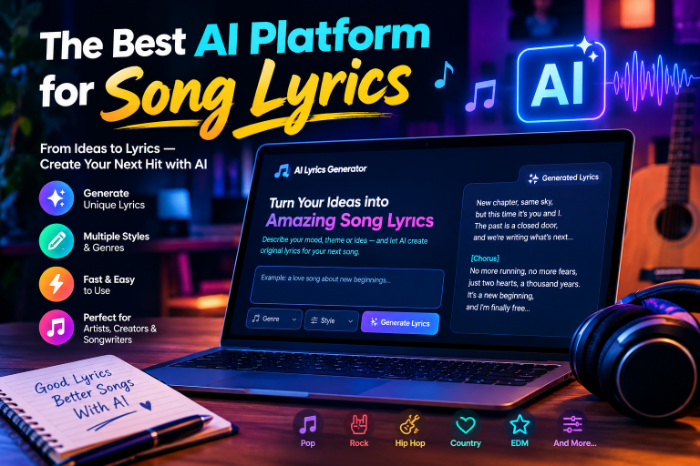
The Best AI Platform For Song lyrics
The Best AI Platform for Song Lyrics (After Testing Way Too Many at 1 AM)
I wrote my first “real” song lyric at a kitchen table with a half-dead laptop, three energy drinks, and absolutely no idea how to get past the second verse. It happens to everyone who writes music — you nail the hook in the shower, sit down to actually write it out, and then… nothing. The chorus feels flat. The verses don’t rhyme without sounding like a greeting card.
That’s the exact moment I started messing around with AI lyric tools. Not to replace my writing — I was skeptical of that idea, honestly — but just to get unstuck. A year and probably 200+ generated songs later, I’ve got some strong opinions about which platforms actually help and which ones just spit out cringe. The Best AI Platform For Song lyrics
If you’re a bedroom producer, a TikTok creator trying to finish a hook before the trend dies, or someone who just wants to write a decent song for a friend’s wedding, this is the honest version of what worked for me.
Why I even bothered trying AI for lyrics
I’m not a trained songwriter. I know chords, I know how to record vocals, but the actual poetry part of songwriting has always been my weak spot. I used to just… give up on songs halfway through. My laptop had a folder called “unfinished” with like 40 voice memos in it.
The first time I tried an AI lyric tool, I expected it to write the whole song for me and I’d just slap my name on it. That’s not really how it works, and honestly, I’m glad it doesn’t. The tools that actually help are the ones that act more like a co-writer sitting next to you, not a vending machine.
The platforms I actually spent time with
Suno — best if you want to hear the song, not just read it
Suno was the first one that genuinely surprised me. You type a prompt like “moody indie pop song about missing someone from your hometown,” and it doesn’t just give you words — it gives you a full track with vocals, melody, and instrumentation.
The lyrics themselves are decent, sometimes really good, but the real magic is hearing them sung immediately. I can’t tell you how many times I thought a lyric worked on paper and then heard it sung out loud and realized the syllables didn’t sit right on the melody at all. Suno exposes that instantly.
Downside: it’s not great for line-by-line control. If you want to tweak one specific word in verse two without regenerating the whole thing, it gets clunky. I ended up using it more for inspiration and demo-ing ideas than for final lyrics I’d actually release.
ChatGPT — the one I go back to most
This one surprised me the most because it’s not even a dedicated music tool. But once I learned how to prompt it properly, it became my main lyric-writing partner.
The trick is being specific. Instead of “write me a sad song,” I’d say something like: “Write a verse in the perspective of someone driving away from their childhood home, AABB rhyme scheme, roughly 8 syllables per line, melancholic but not cheesy.” That level of detail changes everything. The Best AI Platform For Song lyrics
What I like most is that you can go back and forth. “Make the second line less generic.” “Give me three alternate choruses.” “This sounds too much like a Hallmark card, make it more specific and visual.” It genuinely feels like workshopping with a patient collaborator who never gets tired of revisions.
The catch is that ChatGPT doesn’t understand melody or rhythm the way music-specific tools do. It’s purely a words tool. You still have to sing it yourself to check the flow.
LyricStudio — the one built specifically for songwriters
If Suno is for hearing your song and ChatGPT is for flexible brainstorming, LyricStudio sits in the middle. It’s built by people who clearly write songs for a living, not just a general AI writing tool with “lyrics” bolted on.
You pick a genre and topic, start writing, and it suggests ways to continue your line based on rhyme and rhythm as you go. It’s less “generate a whole song” and more “keep me moving when I get stuck,” which honestly matches how songwriting actually feels in real life. You write, you stall, something nudges you forward, you keep going.
Udio — good middle ground for hybrid workflows
Udio lets you either generate lyrics automatically or plug in your own and let the AI handle music around them. I liked this for songs where I already had lyrics I was proud of but wanted to hear them produced quickly to test the vibe before committing studio time to them.
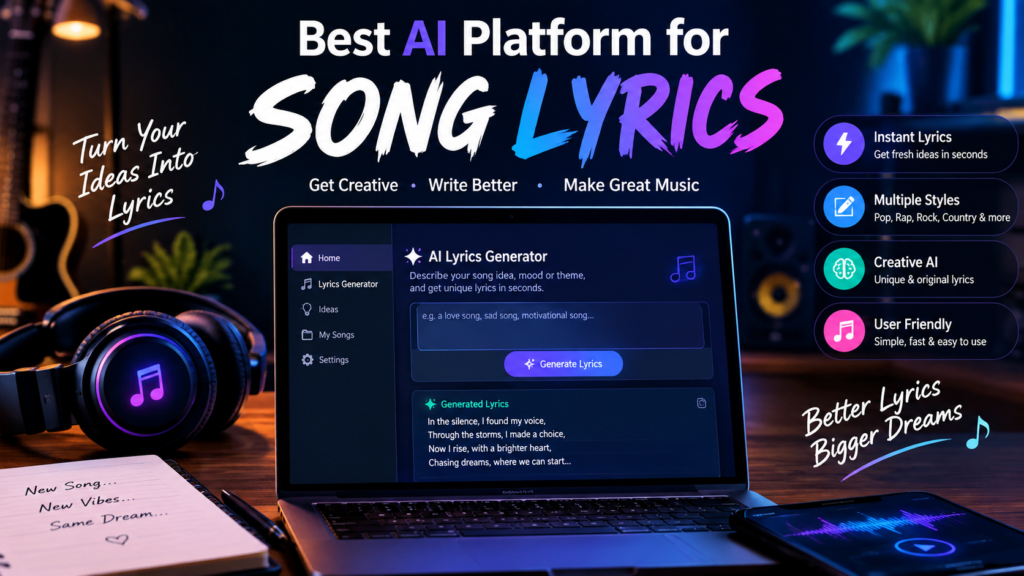
My honest step-by-step process now
Here’s roughly what I actually do these days, tool by tool:
- Start with a real feeling or story, not a prompt. The single biggest mistake I made early on was typing vague prompts like “write a love song.” Vague input gives you vague, generic lyrics every time. Think of one specific memory or image first.
- Draft rough ideas in ChatGPT. I describe the emotion, the specific scene, and any phrases I already like. I ask for multiple versions of each section instead of accepting the first output.
- Test the flow in Suno or Udio. I paste my draft lyrics in and let it generate a melody so I can hear if the syllables and stresses actually land right.
- Rewrite anything that sounds awkward out loud. If a line trips your tongue when sung, it’ll trip everyone else’s too. AI won’t always catch this — your ears will.
- Use LyricStudio when I’m stuck mid-song, specifically for that dreaded second verse or bridge that never wants to cooperate.
Mistakes I made so you don’t have to
Accepting the first draft as final. Early on I’d generate one version and just use it because it “sounded fine.” It never actually was fine — it was generic. Regenerating three or four times and mixing the best lines together always produces something better than any single output. The Best AI Platform For Song lyrics
Not personalizing enough. AI defaults to safe, broad language unless you push it toward something specific. “Walking away in the rain” is a cliché. “Leaving my keys on your kitchen counter because I couldn’t say goodbye out loud” is a lyric. Specificity is everything, and the AI will give you specificity if you ask for it directly.
Forgetting about ownership and originality. A couple of times, generated lyrics were closer to existing songs than I wanted them to be, especially when I gave prompts referencing a specific artist’s style too literally. Always read your lyrics with fresh eyes before releasing anything, and never prompt a tool to imitate a real song directly — that’s asking for trouble both creatively and legally.
Using AI lyrics word-for-word without singing them first. Text that reads well doesn’t always sing well. Always test it out loud, even just recording a rough voice memo, before considering it done.
So which one is actually “the best”?
Honestly, there isn’t one single winner, and I’d be lying if I told you otherwise. It depends on what stage of writing you’re stuck at.
- If you need to hear the idea immediately, Suno wins.
- If you need a flexible writing partner for revisions and specific direction, ChatGPT is hard to beat.
- If you want something built specifically for songwriters with rhyme and flow suggestions baked in, LyricStudio is worth trying.
- If you already have lyrics and want to test production quickly, Udio is solid.
What actually changed my songwriting wasn’t any single app — it was realizing AI is best used as a stuck-point tool, not a starting point. Bring your own story, your own specific memory, your own weird phrase you’ve been chewing on for weeks. Let the AI help you shape it, not invent it from nothing.
The songs I’m actually proud of are still the ones where I did most of the emotional heavy lifting. The AI just helped me get out of my own way faster.








Leave a Reply