


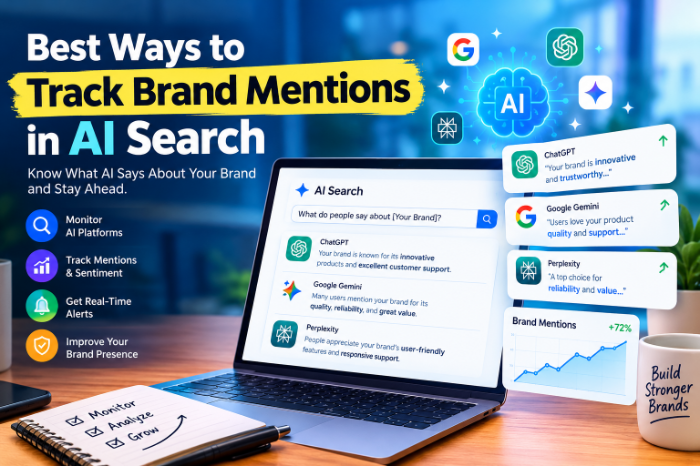
Best Ways To Track Brand Mentions In AI Search
Best Ways to Track Brand Mentions in AI Search (What Actually Works)
A couple of months ago, a client of mine messaged me freaking out. Someone had asked ChatGPT to recommend “the best project management tool for small teams,” and her competitor showed up in the answer — twice. Her brand? Nowhere. Not on page one, not on page ten. Just… absent, like it didn’t exist.
That’s when it hit me. I’d spent years obsessively checking Google Alerts and Ahrefs for brand mentions, but I had zero idea what ChatGPT, Perplexity, or Gemini were saying about her business. And honestly? Neither did most of the marketers I know.
So I went down a rabbit hole for the next few weeks trying to figure out how to actually track this stuff. Here’s everything I learned — including the dumb mistakes I made along the way.
Why This Is Suddenly a Big Deal
Old-school brand monitoring was simple. You’d set up a Google Alert, maybe pay for Mention or Brand24, and you’d get pinged whenever your brand name showed up on a blog, forum, or news site.
But now people aren’t just Googling things. They’re asking AI chatbots directly: “What’s a good alternative to Mailchimp?” or “Which CRM should I use for a 5-person startup?” And the AI just… answers. No ten blue links. No chance for you to argue your case with a meta description.
That’s the part that scared my client, and honestly, it scared me too once I started testing it myself. Best Ways To Track Brand Mentions In AI Search
My First (Failed) Attempt
I’ll be honest — my first instinct was lazy. I just typed a bunch of prompts into ChatGPT manually, like “best email marketing tools 2025,” and screenshotted whatever came up. I did this maybe ten times a day for a week.
It “worked,” in the sense that I got some data. But it was a mess. I had no way to track changes over time, no way to compare across Gemini vs Claude vs Perplexity, and I kept forgetting which prompts I’d already tested. It was basically brand monitoring by vibes.
Lesson learned: manual checking is fine for a quick gut-check, but it’s not a real system. You need something that runs consistently and keeps records.
The Actual Tools That Helped
After a lot of trial and error, here’s what I found genuinely useful.
1. Profound This one’s built specifically for tracking how brands show up across AI answer engines like ChatGPT, Perplexity, and Google’s AI Overviews. It runs prompts on a schedule and shows you exactly when and how your brand gets mentioned (or doesn’t). It’s more of an enterprise-leaning tool, but if you’re serious about this, it’s worth a look.
2. Otterly.ai I liked this one because it’s more approachable for smaller teams. You plug in a set of prompts relevant to your niche, and it tracks your visibility across different AI models over time. Seeing the trend line matters way more than a single snapshot — one good mention doesn’t mean much if it disappears next week. Best Ways To Track Brand Mentions In AI Search
3. Peec AI Similar idea, focused heavily on AI search visibility and competitor comparison. What I appreciated here is that it doesn’t just tell you “you got mentioned,” it shows you the actual context — was your brand recommended positively, mentioned as an alternative, or just listed in passing?
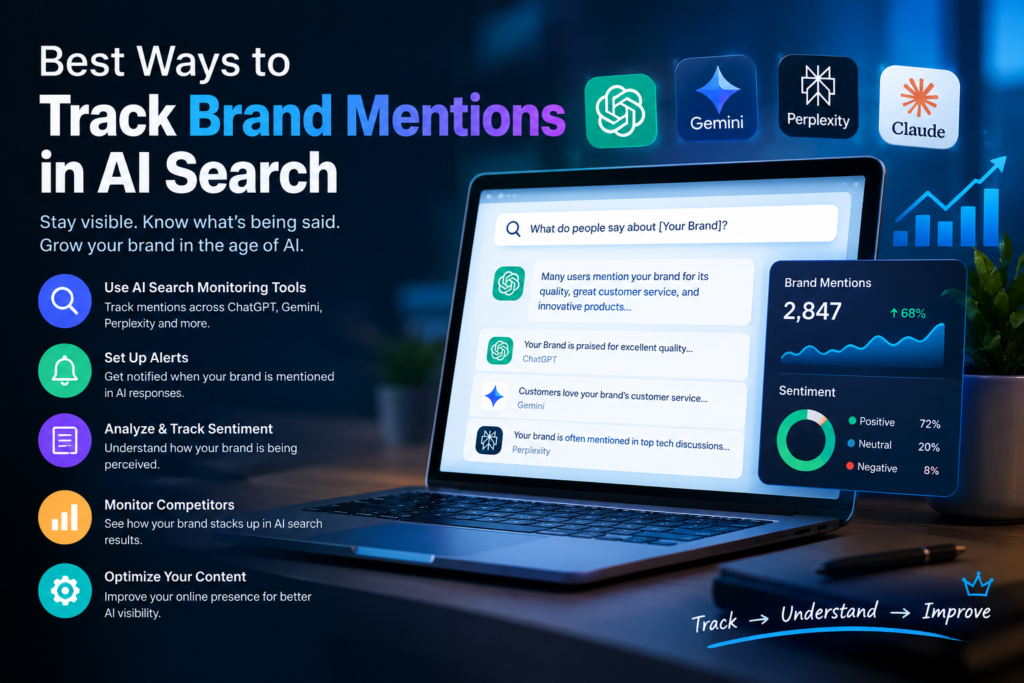
4. Semrush’s AI visibility tools If you’re already paying for Semrush, check their newer AI/LLM tracking features. It’s not as deep as the dedicated tools above, but if you want one dashboard for regular SEO and AI mentions, it’s a decent middle ground.
5. Manual prompt testing (but done properly) Don’t skip this one. Even with paid tools, I still keep a simple spreadsheet where I run the same 15-20 prompts every week across ChatGPT, Perplexity, and Gemini, and log the results. It’s tedious, but it keeps me honest and catches things automated tools sometimes miss, especially with newer models that don’t have API access yet.
Step-by-Step: How I Actually Set This Up
If you want to start tracking this yourself without spending a ton of money right away, here’s roughly what I did:
Step 1: List your “money prompts.” Think about what your customers would actually ask an AI. Not just “[Your Brand] reviews,” but the buying-decision questions — “best tool for X,” “alternative to Y,” “is [competitor] worth it.” I built a list of about 20 of these based on real customer conversations and support tickets.
Step 2: Run them manually first. Before paying for any tool, test your prompt list by hand in ChatGPT, Perplexity, and Gemini. This gives you a baseline and also helps you refine your prompt list — some questions just don’t trigger brand-specific answers at all.
Step 3: Pick one tracking tool and commit to it for a month. Don’t try to use three tools at once like I did. I wasted a good two weeks just comparing dashboards instead of actually acting on the data. Pick one, set your prompts, and let it run.
Step 4: Check weekly, not daily. AI answers don’t change hourly. Checking daily just gives you anxiety, not insight. Weekly is enough to catch real trends.
Step 5: Actually do something with the data. This is the part people skip. If you notice your brand isn’t showing up, ask why. Usually it’s because there isn’t enough clear, structured info about your product online — no comparison pages, no clear “who this is for” content, nothing on review sites like G2 or Capterra. AI models tend to pull from sources that clearly explain what a product does and who it’s for.
A Real Example That Surprised Me
For my client, we found out her product was barely mentioned because she had almost no presence on third-party review sites. Her competitor had dozens of G2 reviews and a Reddit thread where actual users compared the two tools.
We spent about six weeks getting more reviews on G2 and Capterra, and made sure her comparison page directly addressed “brand vs competitor” style questions. When we re-ran the same prompts two months later, she started showing up in about 40% of the relevant AI answers. Not perfect, but a massive jump from zero.
The lesson here isn’t “buy a tracking tool and you’re done.” Tracking just tells you where you stand. The actual fix is usually improving your content and third-party presence so AI models have something solid to pull from. Best Ways To Track Brand Mentions In AI Search
Common Mistakes People
- Only testing one AI model. ChatGPT, Gemini, and Perplexity often give different answers. Don’t assume they’re the same.
- Using vague prompts. “Tell me about [Brand]” isn’t useful. Use the questions your actual customers would ask.
- Checking once and giving up. AI answers shift as models update. One bad result isn’t the full picture.
- Ignoring the “why.” Tracking mentions without investigating why you’re missing is just data collection for its own sake.
- Forgetting traditional SEO still matters. Most AI tools still lean heavily on well-ranked, well-structured web content. Neglecting your regular SEO won’t help your AI visibility either.
Final Thoughts
Tracking brand mentions in AI search isn’t as clean or established as traditional SEO tracking yet — the tools are still catching up, and honestly, so are the AI models themselves. But ignoring it isn’t really an option anymore, especially if your customers are the type to ask a chatbot before they Google something.
Start small. Run your prompts manually for a week or two, pick one tool that fits your budget, and actually act on what you find instead of just watching a dashboard. That’s the part that made the real difference for my client — not the tracking itself, but what we did once we saw the gaps.






Leave a Reply