


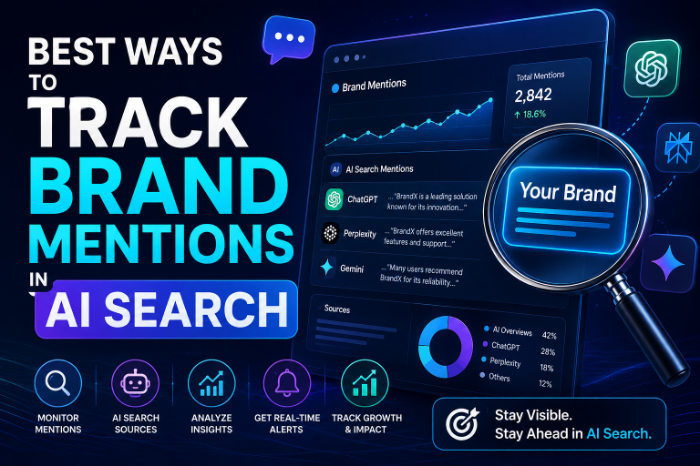
Best Ways To Track Brand Mentions In AI Search
Best Ways to Track Brand Mentions in AI Search (What Actually Works in 2026)
I found out my business had a problem the embarrassing way — a customer messaged me on Instagram asking “hey does your app actually integrate with Notion like ChatGPT said it does?”
It didn’t. ChatGPT had just… made that up. Or pulled it from some outdated blog post that mentioned a feature we killed two years ago.
That was the moment it hit me: people aren’t just Googling my brand anymore. They’re asking ChatGPT, Perplexity, and Gemini what my brand does, whether it’s good, and how it stacks up against competitors — and I had absolutely zero visibility into any of that conversation.
If you’ve felt that same low-grade panic, you’re not alone. Let’s talk about how to actually track this stuff, without turning it into a full-time job.
Why This Is Suddenly a Real Problem
For years, brand monitoring meant Google Alerts, maybe a Mention.com or Brand24 subscription, and checking your Google rankings. That covered “the internet” pretty well because almost all traffic flowed through search results or social feeds you could see.
AI chat tools broke that model. When someone asks ChatGPT “what’s the best project management tool for a 5-person team,” it just… answers. No results page. No list of ten blue links you can rank-check. Just an opinion, generated on the spot, that either includes your brand or quietly doesn’t.
And here’s the part that messed with my head for a while: the answer isn’t even consistent. Ask the same question twice and you might get a different set of brands mentioned. It’s not a stable ranking — it’s more like a mood that shifts based on phrasing, recent web content, and honestly some randomness baked into how these models generate text.
That means “checking once” tells you almost nothing. You need repeated sampling over time to see a real pattern.
What I Tried First (And Why It Didn’t Really Work)
My first instinct — and I bet this is yours too — was to just manually type questions into ChatGPT and Perplexity every few days and see if my brand showed up.
It kind of worked, for about a week. Then I got busy, forgot to check, and realized I had no record of past answers to compare against. Was my brand showing up more or less than last month? No idea. I hadn’t saved anything.
Lesson learned: manual spot-checking is fine for a gut check, but it’s useless for tracking a trend. You need something that runs the same prompts on a schedule and actually logs the results.
The Tools That Actually Help
Once I started looking seriously, I realized this had become its own little software category — sometimes called AI search visibility, generative engine optimization (GEO), or answer engine optimization (AEO) tools. A few worth knowing about:
Otterly.AI — This was the first one I tried, mostly because setup was fast. You plug in the prompts you care about (“best CRM for startups,” “alternatives to X,” whatever your buyers actually ask), and it runs them across ChatGPT, Perplexity, and Google AI Overviews on a schedule, then shows you when you’re mentioned and when you’re not.
Profound and Peec AI — These lean more enterprise, with heavier competitor benchmarking and sentiment scoring across more engines (Gemini, Claude, Copilot, Grok included in some cases). Pricier, but if you’re at a company where marketing has to report “share of voice” to leadership, this is the kind of tool that speaks that language.
Semrush’s AI toolkit and Ahrefs’ Brand Radar — If you already pay for Semrush or Ahrefs for regular SEO, check whether your plan includes their newer AI visibility features. It’s convenient to have it sitting next to your normal rank tracking instead of paying for a whole separate platform.
Siftly and MaxAEO — Smaller, more affordable options if you’re not ready to commit to enterprise pricing but still want scheduled tracking across multiple AI engines instead of manually checking each one. Best Ways To Track Brand Mentions In AI Search
None of these are perfect. Some undercount mentions, some overcount, and every single one of them will tell you their numbers are “directional” rather than exact. That’s honestly the right way to think about all of it — directional signal, not a precise scoreboard.
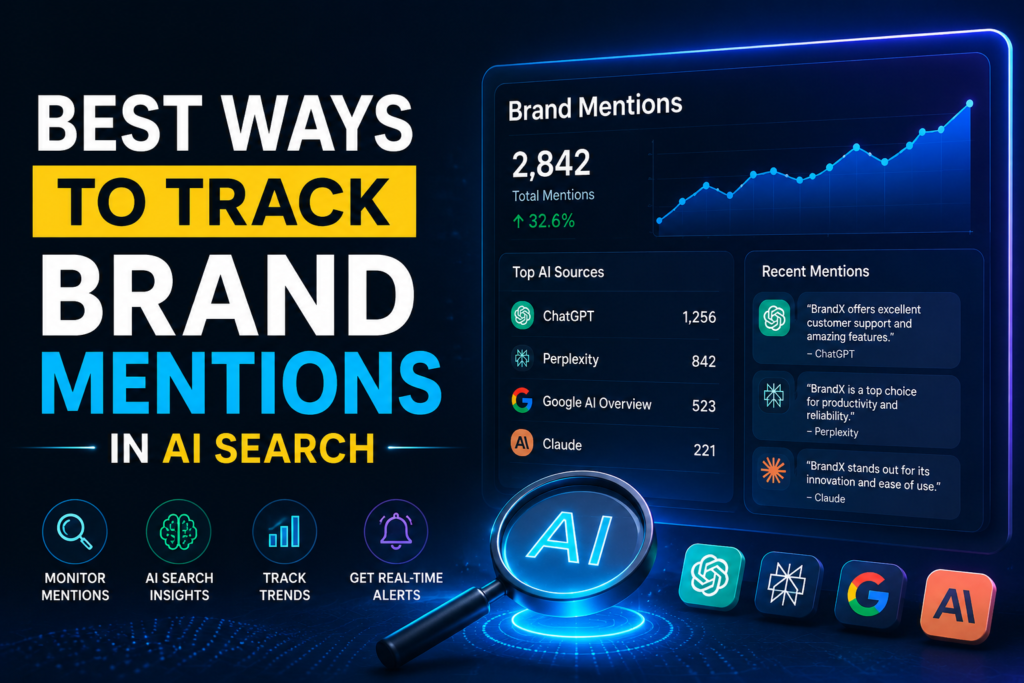
Doing It Yourself (No Budget Required)
If you’re not ready to pay for a tool, you can absolutely build a manual system. It’s more work, but it costs nothing and teaches you a lot about how these engines actually behave.
Here’s the process I used before I paid for anything:
Step 1: Write down the questions your actual customers would ask. Not generic stuff like “what is [your industry].” Real buying questions — “best [product category] for small teams,” “[your brand] vs [competitor],” “is [your brand] worth it.”
Step 2: Run each question in ChatGPT, Perplexity, and Google (to trigger AI Overviews) — three to five times each. Not once. The variation between runs is the whole point of noticing.
Step 3: Log it in a simple spreadsheet. Columns for: date, engine, prompt, was your brand mentioned (yes/no), what was said about it, which competitors showed up instead, and whether there was a clickable source link.
Step 4: Repeat weekly. Not daily — that’s overkill unless you’re actively fighting a visibility problem. Weekly is enough to catch real trends without burning your afternoon.
Step 5: Look for patterns, not single data points. One missed mention means nothing. Three weeks of your brand disappearing from the same prompt while a competitor appears every time — that’s a signal worth acting on.
I still keep a lightweight version of this spreadsheet running even though I now use a paid tool, mostly because it forces me to actually read the answers instead of just glancing at a dashboard percentage.
A Real Example of What This Looks Like
One prompt I track is “best tools for [my category] freelancers.” For months, my brand showed up in maybe 1 out of 5 Perplexity runs. Then I rewrote our homepage and a couple of key blog posts to more directly and clearly state what we do, who it’s for, and how it compares to alternatives — basically wrote it the way I’d want an AI to summarize it.
Six weeks later, that same prompt was returning my brand in about 4 out of 5 runs on Perplexity. ChatGPT took longer to catch up, which lines up with something I’ve noticed generally: Perplexity updates fastest because it searches live, while ChatGPT leans more on training data and cached web knowledge, so changes show up slower there. Best Ways To Track Brand Mentions In AI Search
That was a genuinely useful, actionable result — not just “interesting data,” but something that changed what I prioritized writing next.
Mistakes People Make With This (I made most of them)
Only checking ChatGPT. It’s the most famous one, but Perplexity, Gemini, Google AI Overviews, and even Copilot all pull from different sources and behave differently. If you only watch ChatGPT, you’re missing most of the picture.
Treating one bad answer as a crisis. These models are inconsistent by nature. One weird or wrong mention isn’t a trend — it’s noise. Wait for a pattern before you panic or pivot.
Ignoring negative sentiment. Getting mentioned isn’t automatically good. I once found my brand described as “budget-friendly but limited in features” in a Perplexity answer — technically a mention, but not exactly a great look. Read what’s actually being said, not just whether your name showed up.
Forgetting that citations matter more than mentions. If an AI tool links back to a specific page on your site as its source, that’s gold — it means your content is actually shaping the answer, and sometimes you’ll get real traffic from that click. A mention with no citation is more like word-of-mouth you can’t trace.
Expecting instant results after content changes. Whatever you fix on your site, it takes weeks, not days, to show up in AI answers, especially the ones trained on older data. Patience matters here more than it does with normal SEO. Best Ways To Track Brand Mentions In AI Search
Where This Is All Headed
Honestly, this whole space is still figuring itself out. The tools are improving fast, but there’s no universal standard yet for what “visibility in AI search” even officially means — every platform measures it a little differently.
My honest advice: pick two or three prompts that actually matter to your business, track them consistently (manually or with a tool), and pay more attention to the trend line than any single answer. That’s been the thing that’s actually moved the needle for me — not chasing every new tool that launches, but staying consistent with watching the same handful of questions over time.




Leave a Reply