


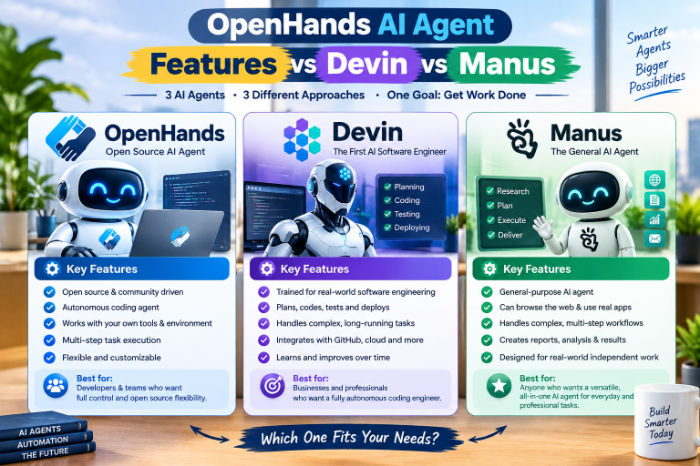
Openhands AI Agent Features VS Devin VS Manus
OpenHands vs Devin vs Manus:
OpenHands, Devin and Manus all promise to do work for you. Here’s how they differ on cost, control and real-world fit, and how to test them yourself.
You know that GitHub issue that’s been sitting in your backlog for three weeks? The one that isn’t hard, just tedious: update a dependency, fix the three tests it breaks, and write a changelog note.
That’s exactly the kind of job AI agents are pitched at. But “AI agent” now covers tools that behave very differently. OpenHands, Devin and Manus get lumped together constantly, and picking the wrong one for your job means wasted money or wasted afternoons.
Let’s sort it out.
First, they’re not really the same kind of tool
line up all three in a spreadsheet as if they compete head to head. They don’t, quite.
- OpenHands and Devin are software engineering agents. They read code, edit files, run commands and try to finish dev tasks.
- Manus is a general-purpose agent. Coding is one thing it can do, but research, web tasks and building simple apps are its bigger pitch.
OpenHands: the one you can open up and control
OpenHands used to be called OpenDevin, and the name tells you what it was originally chasing. It’s MIT-licensed, open source, and can edit files, run terminal commands, browse the web and carry out multi-step development tasks.
The features that matter in practice: Openhands AI Agent Features VS Devin VS Manus
It’s model-agnostic. You can run it with Claude, GPT, DeepSeek, Qwen, Llama, or even local Ollama models. If you care about not being locked to one AI vendor, this is the big one.
It runs in a sandbox. Docker-sandboxed execution is the default, so the agent isn’t free-roaming across your actual machine.
There are several ways in. The team ships an SDK, a CLI, and a newer Agent Canvas, a self-hosted control center that can also run Claude Code, Codex, Gemini or any ACP-compatible agent. There are also cloud and enterprise options if you’d rather not host it.
The catch: the software is free, but the AI model calls aren’t. You pay your model provider directly, and you’re responsible for setup and security. The project’s own docs point out that cloud hosting needs security hardening if you go that route.
ADD YOUR OWN: How long did setup take you? Which model did you connect?
Devin: the polished, hosted one
You hand it a task, it works in its own cloud environment, and you review the result.
According to one pricing breakdown, every tier includes the Devin agent with sandboxed VM execution, browser and terminal access, and integrations with GitHub, GitLab, Linear, Jira, Slack, Notion and Sentry, with Cognition hosting the VMs so you don’t bring compute.

That’s the appeal: nothing to install or host. Devin picks up a ticket and works on it while you do something else.
Pricing is where you need to be careful. Devin’s plans have changed a lot, and sources don’t fully agree. One July 2026 breakdown lists Free, Pro at $20/seat, Max at $200/seat, and Teams at $80 base plus $40/seat, with extra on-demand credits for heavy autonomous runs. Another notes that the free plan is now just the Devin Desktop download, while cloud agents are paid-only. Devin Desktop is the rebranded Windsurf editor, since Cognition rebranded Windsurf to Devin Desktop in June 2026.
So: don’t trust any blog’s price table, including this one. Check Cognition’s pricing page the day you sign up.
[ADD YOUR OWN: What task did you give Devin? How much did it actually cost you, and was the result mergeable as-is?]
Manus: the “do things on the internet” one
Manus isn’t a coding-first tool. It’s a general agent that works inside a virtual computer. It shines on jobs like researching a topic, comparing options and delivering a structured report. One review notes it can independently browse websites, extract data and deliver a comparison table from a plain-English prompt, and that it has since added a web app builder.
Costs work on credits. The free plan gives 300 daily refresh credits, and paid plans run from $20 to $200 a month. The same source warns there’s no hard pre-task cost estimate and no “stop at X credits” control, so power users sometimes burn through a $20 plan in a weekend. Openhands AI Agent Features VS Devin VS Manus
There’s also a business-risk footnote. Meta bought Manus for about $2B, but China’s state planner blocked the deal on April 27, 2026 and ordered it unwound. Reports say the product continues to run normally but ownership was unresolved as of mid-2026, so check the latest before building a workflow around it.
[ADD YOUR OWN: A real research or web task you gave Manus, how many credits it used, and whether the output needed fact-checking.]
Quick comparison
| OpenHands | Devin | Manus | |||
| Main strength | Control and flexibility | Hands-off dev tasks | Research and web tasks | ||
| Where it runs | Your machine or your servers (or their cloud) | Cognition’s cloud | Manus’s cloud (plus a desktop app) | ||
| Model choice | Almost any | Cognition’s choice of models | Manus’s choice | ||
| Cost shape | Free software + your model bills | Subscription + usage | Credits | ||
| Best for | Tinkerers, teams with privacy needs | Teams that want to delegate | Non-coding tasks |
How to test them yourself (the only comparison that matters)
Reviews, including mine, only go so far. Your codebase and habits are different.
Pick one small, boring task. Something like “add input validation to this form and write tests.” Avoid anything huge on round one.
- Use a throwaway or low-stakes repo. Never give an experimental agent your production repo on day one.
- Write the task like a good ticket. State the goal, the files involved, what “done” looks like, and what not to touch.
- Run the identical task on each tool. For Manus, use a research equivalent instead of a coding task.
- Track three numbers: time until you had a usable result, money spent, and how much you had to fix by hand.
- Review everything like a junior developer’s pull request. Read every line before it merges.
Mistakes worth avoiding
Vague prompts. “Improve my app” gets you confident, sprawling changes. The agent doesn’t know what “improve” means to you, and you pay for the guessing.
No spending limits. Usage-based tools can run longer than you expect. Set alerts or caps wherever the platform allows it.
Skipping the sandbox. If you self-host OpenHands, keep it isolated and don’t hand it credentials it doesn’t need.
Judging Manus on a coding task. It’s built for a different job.
Trusting the output. Agents can be wrong while sounding certain. Anything factual, financial or customer-facing needs a human check.
So which one?
Here’s how I’d think about it:
- Want control, flexibility or privacy, and don’t mind setup? Start with OpenHands.
- Want to delegate tickets to something hosted and don’t mind paying per usage? Try Devin’s cheapest paid tier on one real task first.
- Want research, comparisons or quick web tools, not code? Manus is the closest fit, but watch your credits.
And if you’re not sure, start with whichever has the smallest downside: OpenHands with a cheap model on a throwaway repo costs you almost nothing to learn from.








Leave a Reply