


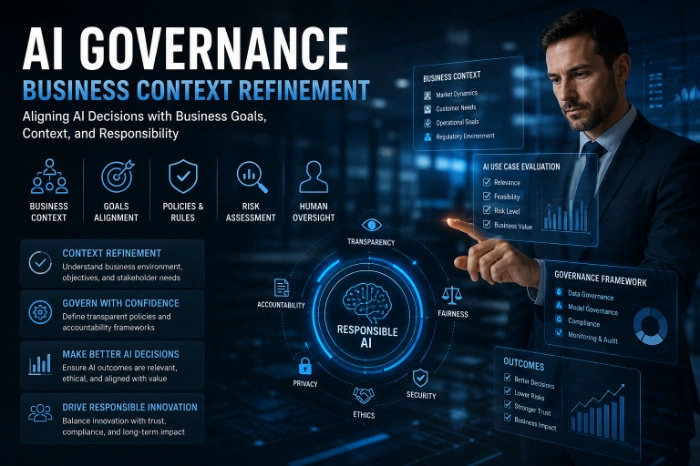
AI governance business context refinement
AI Governance Business Context Refinement: What I Learned After Watching Our First AI Policy Fail Miserably
A little over a year ago, I sat in a conference room while our compliance lead read out our brand-new “AI Governance Policy” to a room full of confused engineers and even more confused sales people. It was 14 pages long. It had been copy-pasted, mostly, from a template someone found online. And within three weeks, nobody was following it.
Not because people didn’t care. Because it didn’t match how our business actually worked. AI governance business context refinement
That’s the moment I really understood what “business context refinement” means in AI governance. It’s not a fancy phrase consultants use to sound smart. some imaginary company that exists only in a template.
Why Generic AI Policies Fall Apart
Here’s the thing nobody tells you when you start building an AI governance framework: the frameworks themselves (NIST AI RMF, ISO 42001, the EU AI Act obligations) are genuinely good. They’re not the problem.
The problem is that most companies grab one of these frameworks, print it out, and expect it to just… work. Like buying a suit off the rack and assuming it’ll fit perfectly without any tailoring.
In our case, our first policy assumed we had a dedicated AI ethics board. We didn’t — we had four people wearing six hats each. It assumed every AI use case went through a formal procurement process. In reality, half our teams were quietly using ChatGPT, Claude, or random AI plugins they found on Slack without telling anyone.
So the policy sat in a shared drive, unread, while actual AI usage kept happening in the shadows. This is incredibly common. A 2024 survey I came across while researching our rebuild found that most employees at companies with AI policies still used unsanctioned AI tools anyway — because the policy didn’t reflect how work actually got done.
That’s what business context refinement fixes.
What “Business Context Refinement” Actually Means
Strip away the jargon and it’s basically this: adjusting your AI governance rules so they match your company’s size, industry, risk tolerance, tech stack, and culture — instead of applying a one-size-fits-all rulebook.
A hospital system building diagnostic AI tools has wildly different risks than a marketing agency using AI to draft social captions. Both technically need “AI governance.” But if you hand the marketing agency the same 40-page risk assessment framework a hospital needs for FDA-adjacent tools, they’ll ignore it. It’s overkill, and everyone knows it.
Refinement means asking uncomfortable but necessary questions: AI governance business context refinement
- What does our business actually do with AI, right now, today?
- Who’s using it, and are they even aware there’s a policy?
- Where’s the real risk — legal, reputational, financial, safety?
- What’s realistic for our team size to actually enforce?
How We Actually Rebuilt Ours (Step by Step)
I’ll walk through what worked for us, because I think the process matters more than any template.
Step 1: We ran an AI usage audit first, policy second
Before writing a single new rule, we spent two weeks just finding out what AI tools people were actually using. We used a mix of things — a simple anonymous survey, checking our SSO logs through Okta for AI tool sign-ins, and reviewing expense reports for AI subscriptions nobody had “approved.”
The result was humbling. We found over 30 different AI tools in active use across departments, from Grammarly and Notion AI to some browser extensions nobody in IT had ever heard of.
You can’t govern what you don’t know exists. This step alone should come before any policy rewrite.
Step 2: We mapped risk by department, not company-wide
Instead of one blanket rule for “AI use,” we broke it down by function. Marketing using AI for copy drafts is low risk. HR using AI to screen resumes is high risk (hello, discrimination lawsuits). Finance using AI-assisted forecasting is medium risk depending on how much weight decisions carry.
We used a simple traffic-light system — green, yellow, red — for different use cases. It’s not sophisticated, but it’s something people actually understood at a glance, which matters more than sophistication.
Step 3: We rewrote policy language for the people who’d read it
Our original policy sounded like a legal document. Our second draft was written more like internal documentation — short sentences, real examples, no unnecessary legalese. Instead of “Employees must ensure appropriate due diligence prior to deployment of generative AI systems in customer-facing contexts,” we wrote something closer to: “If an AI tool is going to talk to customers directly, run it by the AI review group first. Here’s how.”
Nobody misunderstands that second version.
Step 4: We picked tools that matched our actual size
We looked at platforms like Credo AI, OneTrust AI Governance, and ServiceNow’s AI governance modules. All solid tools — but honestly overkill for a company our size at the time. We ended up building a lightweight intake form in Airtable where anyone requesting to use a new AI tool just fills out five questions. It routes to one person for review. That’s it.
Bigger companies genuinely need the heavier platforms. Smaller ones often don’t, and forcing an enterprise tool onto a 50-person team just creates friction people route around.
Step 5: We built in a review cycle, not a “set it and forget it” document
This was probably our biggest early mistake — we treated the first policy like a legal contract you sign once and file away. AI tools change monthly. New regulations (the EU AI Act rollout being a good example) shift obligations over time. We now review our governance approach every quarter, which sounds like a lot, but it’s really just a 45-minute meeting checking what’s changed.
Real Examples That Made This Click for Me
One thing that helped our leadership actually take this seriously was a real incident at another company in our industry — a recruiting firm that used an AI screening tool which ended up filtering out candidates based on patterns correlated with age and gender, without anyone realizing it until an external audit flagged it. That wasn’t a hypothetical “AI risk” in a slide deck. That was a lawsuit and a PR mess. AI governance business context refinement
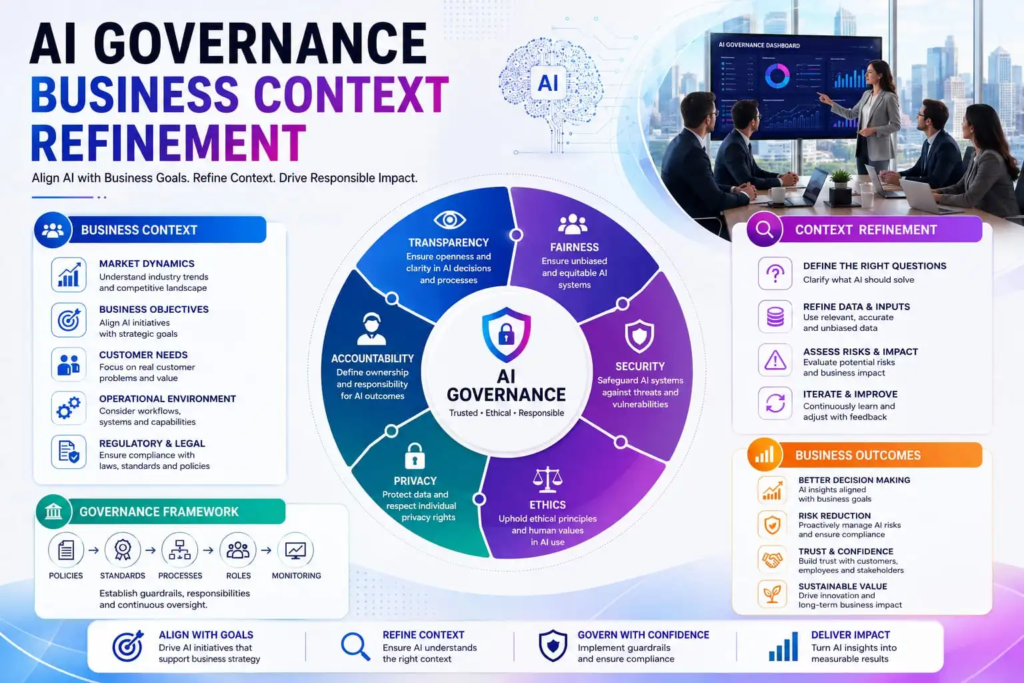
Sharing stories like that internally did more to get buy-in than any policy document ever could.
Another small but telling example: one of our engineers had been feeding client contract drafts into a free AI writing tool to “clean up the language” before sending them out. Totally innocent intention. But that free tool’s terms of service allowed them to use input data for model training. Nobody had checked. That one incident alone justified the entire governance rebuild in the eyes of our legal team.
Common Mistakes I See Companies Make
Copying a template word-for-word. Frameworks are a starting skeleton, not a finished body. If your policy reads like it could belong to any company, it probably doesn’t actually fit yours.
Skipping the audit step. You cannot govern AI use you don’t know is happening. Find out first.
Making it too complicated to follow. If your policy needs a law degree to interpret, employees will just ignore it and keep doing what they were doing.
Treating governance as an IT-only problem. It touches HR, legal, marketing, product, and leadership. Leaving any of them out creates blind spots.
Never revisiting it. AI tools and regulations move fast. A governance policy written in 2023 language is already stale in 2026.
No clear owner. If nobody specific is responsible for approvals and updates, the whole system quietly rots.
A Simple Framework You Can Start With Today
If you’re starting from scratch, here’s roughly the order I’d follow:
- Audit current AI tool usage across departments (survey plus SSO/expense checks)
- Categorize use cases by actual risk level, not assumed risk
- Draft plain-language rules for each risk tier
- Assign one clear owner for reviewing new AI tool requests
- Pick a review tool that matches your company size (spreadsheet, Airtable, or a dedicated platform like Vanta or OneTrust if you’re larger)
- Set a recurring review date on the calendar — not “someday”
Final Thoughts
Honestly, the biggest shift for me wasn’t learning some new framework. It was realizing governance only works when it reflects how your business actually operates, not how a template author imagined a business might operate.
The companies that get this right treat AI governance less like a compliance checkbox and more like an evolving conversation between legal, engineering, and whoever’s actually using these tools day to day. It’s messier than a clean 14-page PDF. But it’s the only version that people actually follow.
If you’re building or refining your own AI governance approach, start with the audit. You’ll probably be surprised — maybe uncomfortably so — by what you find already happening under the radar. AI governance business context refinement








Leave a Reply