


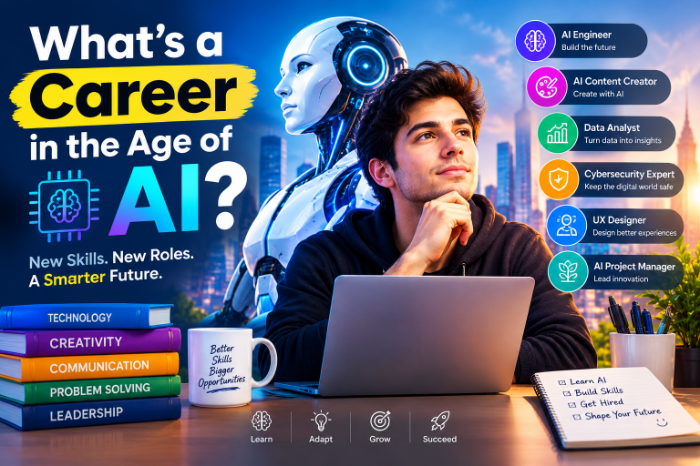
What’s A Career In The Age Of AI
What’s a Career in the Age of AI? A Practical Guide to Staying Useful at Work
Last year I watched a friend of mine, a very good copywriter, go quiet in the middle of a dinner.
Someone at the table had just shown how a chatbot wrote a full product page in about ten seconds. She laughed along, but later she told me, “I’ve spent eight years learning to do that. What am I supposed to do now?”
I didn’t have a great answer that night. I do now, after a lot of experimenting with AI tools in my own work, plenty of awkward mistakes, and reading what the research is actually saying instead of what the headlines scream.
So if you’re wondering what a career even means anymore, whether you’re a student, a mid-career professional or someone thinking about switching paths, this one’s for you.
First, take a breath: it’s changing, not ending
The loudest voices online either say AI will take every job or that nothing will change. Both are wrong.
What the data seems to show is more interesting. PwC’s 2026 Global AI Jobs Barometer, which analyzed over a billion job ads, found that entry-level jobs most exposed to AI are far more likely to ask for skills that used to belong to senior people, such as judgment, leadership and decision-making. Job-market researchers describe this as entry-level work being redesigned rather than simply deleted.
Surveys from the National Association of Colleges and Employers point the same way: more than a third of entry-level employers now say AI skills are required, and that share has roughly tripled since fall 2025.
What that means in plain English: the boring, repeatable parts of many jobs are being automated, and the human parts are becoming more valuable. The job isn’t disappearing so much as moving up a floor.
I’d treat these numbers as a direction, not a prediction about your specific job. Industries differ a lot, and nobody can promise you how it’ll play out.
What a career actually looks like now
Here’s how I think about it after trying to adapt my own work:
- Tasks change faster than job titles. Your title may stay the same while half your daily tasks change.
- Careers look less like ladders and more like skill stacks. You collect abilities, and each one makes the others more useful.
- Being able to work with AI is becoming a baseline skill, a bit like being comfortable with email or spreadsheets.
- Learning never really stops. That sounds exhausting, but it gets easier once you build a routine.
My own wake-up call (and a mistake)
When I first started using AI tools for writing and research, I made two classic mistakes.
First, I copied the output almost directly. It read fine, but it sounded like nobody in particular. A reader who knew me asked if I’d been “hacked.”
Second, I trusted a confident-sounding fact that turned out to be wrong. It wasn’t a disaster, but I had to publish a correction, and it taught me a lesson I haven’t forgotten: AI is a fast assistant, not a source of truth. You’re still the one responsible.
After that, I changed how I work. I use tools like ChatGPT, Claude and Gemini to brainstorm, outline, summarize and challenge my thinking. Then I do the verifying, the opinions and the final voice myself. The work got faster and better, which was the opposite of what I feared.
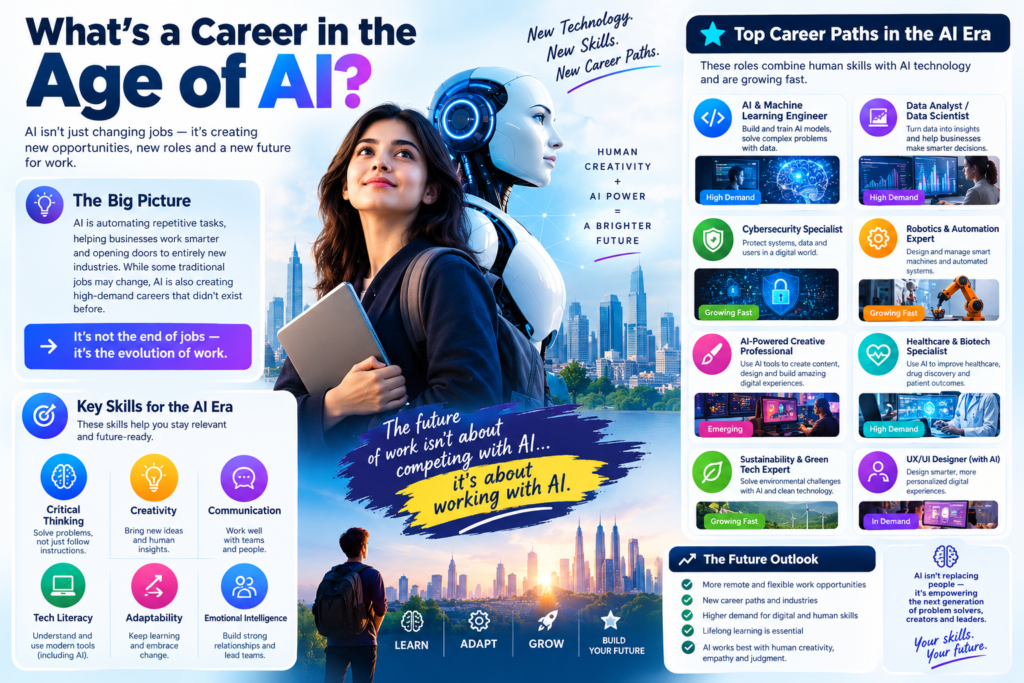
The skills worth building
Here’s what I’d focus on, in order of how much difference I’ve seen them make.
1. Judgment and critical thinking. AI can produce ten options. Someone has to pick the right one and explain why. Practice questioning outputs: Is this accurate? Who is it for? What’s missing?
2. Communication. Clear writing, honest conversations and good presentations stand out more as generic text becomes cheap. Being understood is still a human advantage.
3. AI fluency. You don’t need to code. You do need to know how to write a clear prompt, check the answer, and fit a tool into your workflow.
4. Domain knowledge. AI is a powerful engine, but it needs a driver who understands the road. The more you know about your field (healthcare, logistics, teaching, finance), the better you can tell when the tool is wrong.
5. Adaptability. The people who do well are usually the ones who stay curious and try new things without panic.
6. People skills. Trust, empathy, negotiation, mentoring and leading a team are very hard to automate. They’re also hard to learn from a screen, so practice them in real life.
A simple 30-day plan to get started
If you feel behind, here’s a realistic way to begin without burning out.
Week 1: Look at your own job.
- Write down your tasks for a normal week.
- Mark which ones are repetitive (reports, summaries, first drafts, data entry).
- Mark which ones need judgment, relationships or creativity.
The repetitive list is where AI can help. The second list is where you should invest your growth.
Week 2: Try one tool on one task.
- Pick a free tool such as ChatGPT, Claude, Gemini or Microsoft Copilot (depending on what your workplace allows).
- Choose one low-risk task, like summarizing a long document or drafting an email.
- Compare the AI draft with your own. Note what it got right and wrong.
Week 3: Build a small habit.
- Use the tool for 15 minutes a day on real work.
- Save prompts that work in a notes app.
- Always verify names, numbers and claims before using them.
Week 4: Show something for it.
- Create one small project: a better report template, a faster research process, a mini case study.
- Write down the time you saved or the quality you improved.
- Share it with your manager or add it to your portfolio or CV.
It doesn’t have to be impressive. It just has to be real.
Real-life examples that gave me hope
- A teacher I know uses AI to draft quiz questions and lesson outlines, then spends the saved time on one-to-one help for struggling students.
- A freelance designer uses AI to generate quick mood boards and rough concepts, but wins clients by understanding their brand and giving honest advice.
- An accountant uses automation to speed up routine reconciliation and now spends more time advising small businesses.
- My copywriter friend from the dinner? She now uses AI for first-draft structure and spends her energy on strategy, brand voice and client workshops. Her rates went up, not down.
These are small examples, not guarantees, but they share a pattern: the person moved toward the parts of the job that need a human.
If you’re early in your career
This group has it toughest right now, and it’s worth being honest about that. Some traditional junior tasks are shrinking, and employers expect more from newcomers.
A few things that help:
- Build proof, not just credentials. A small portfolio, a volunteer project or a published case study speaks louder than a line on a CV.
- Learn in public. Share what you’re learning and what you built.
- Find a mentor, even informally. Judgment is learned from people.
- Say yes to messy, varied tasks. They teach the skills AI can’t easily copy.
- Be upfront about using AI well. Employers increasingly value people who can use it responsibly.
If you’re mid-career or changing paths
Your experience is an asset. Many people forget this. Years of context, mistakes and relationships are exactly what the tools lack.
Pair that experience with basic AI skills, and you become the person who can both spot a bad output and ship good work quickly. Consider small certificates or short courses from places like Coursera, LinkedIn Learning or Google’s training programs, but don’t collect certificates for their own sake. Use each new skill on a real project.
Mistakes to avoid
Panicking and doing nothing. Fear feels productive but isn’t. Small steps beat big worry.
Chasing every new tool. There’s a new app every week. Pick two or three and get good at them.
Trusting AI blindly. Check facts, sources and numbers, especially for anything public or high stakes.
Sharing sensitive data. Don’t paste confidential client or company information into public tools. Follow your workplace’s rules.
Hiding your AI use. If your company has a policy, follow it. If it doesn’t, ask. Honesty protects your reputation.
Ignoring human skills. The most technical person in the room still needs trust and clear communication.
Waiting for a perfect plan. Nobody has one. Try, adjust, repeat.
Where I’ve landed
I used to think the question was “Will AI take my job?” Now I think a better question is “Which parts of my work should I hand off, and which parts should I get really good at?”
That shift made me calmer. It also made me more useful, which is probably the best security any of us can build.
If you do one thing this week, write down the tasks you do and pick one to test with an AI tool. Check the result with a skeptical eye, then improve it with your own judgment. That small loop, repeated over time, is what a career in this era mostly looks like.







Leave a Reply