


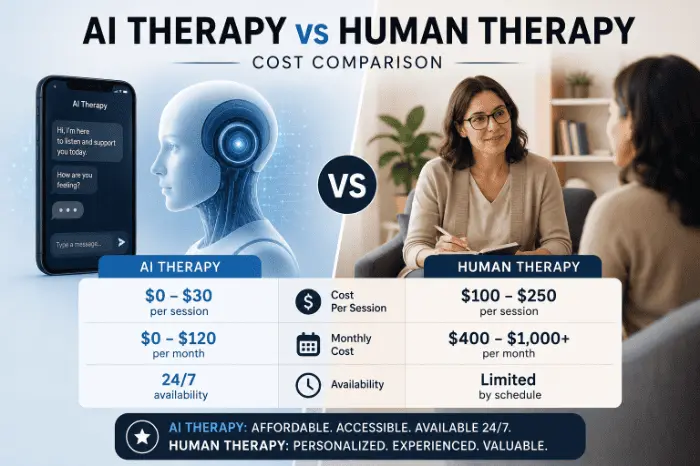
Therapy cost comparison ai and human
AI Therapy vs Human Therapy: What I Actually Spent (And What I Wish I Knew Sooner)
Last winter I hit a point where I couldn’t keep pretending I was fine. Work stress, some family stuff, the usual pile-up. I opened my banking app to see if I could afford a therapist and nearly closed it again when I saw what a single session in my city costs. Then a friend mentioned she’d been using an AI chatbot app for her anxiety instead, paying less than the price of a pizza per month.
That comparison stuck with me. So I did what any curious, slightly broke person would do — I tried both. For about four months, I split my time between a licensed human therapist and a couple of AI-based mental health apps, just to see what actually happened to my wallet and my head.
Here’s the honest breakdown, mistakes included.
Why I Even Started Comparing
I want to be upfront: I’m not a doctor, and this isn’t medical advice. I’m just someone who went through the cost math because therapy in the US (and honestly most places now) has gotten stupidly expensive.
My first human therapy session was $180. No insurance covered it because my plan had a huge deductible I hadn’t hit yet. That’s when I started wondering if an app could hold me over until I could actually afford consistent sessions.
What Human Therapy Actually Cost Me
Over three months, here’s what I tracked with an in-network licensed therapist (using a directory through Psychology Today to find her, for what it’s worth):
- First session (intake): $180
- Weekly sessions after that: $130 each
- Total for 12 weeks: roughly $1,610
Once my insurance deductible kicked in, my copay dropped to $40 a session, which felt like a miracle. But that took almost two months of paying full price before insurance actually helped.
Lesson learned the hard way: always call your insurance company before booking and ask specifically about mental health copays and deductible status. I assumed my plan worked like my regular doctor visits. It didn’t. Big mistake, cost me a few hundred extra dollars I didn’t need to spend.
What the AI Apps Actually Cost Me
I tried two different tools during the same stretch:
Wysa — has a free version with basic chat support, and a premium tier around $99/year (roughly $8/month) that unlocks more structured CBT-style exercises and a “coach” feature.
Woebot — free at the time I used it, though its availability and features have shifted since, so definitely check current pricing before assuming.
I also tested BetterHelp, which technically blends human therapists with an app interface, so it’s not pure AI — but I mention it because a lot of people lump it into this comparison. That ran me about $260–$360 a month depending on the plan, billed as a subscription rather than per session.
So the real “AI-only” apps were shockingly cheap. Wysa cost me less in an entire year than one single session with my human therapist.
The Real Difference Wasn’t Just Price
Here’s where it gets interesting, and where I think most cost comparison articles miss the point.
The AI apps were great for:
- Journaling prompts when I couldn’t sleep
- Quick breathing exercises before a stressful meeting
- Catching negative thought patterns in the moment, like at 2am when no human therapist is awake anyway
But when I brought up something genuinely heavy — a specific childhood memory that kept resurfacing — the chatbot responses started feeling repetitive. Kind, but shallow. It would reflect my words back at me in a slightly different order, which is a real CBT technique, but it didn’t feel like it was actually understanding the weight of what I said.
My human therapist caught something in session six that I hadn’t even consciously connected — a pattern between how I react to criticism at work and something from my teenage years. No app flagged that. It took a person paying attention over multiple weeks to notice.
So yes, the AI was cheaper. But it wasn’t doing the same job.
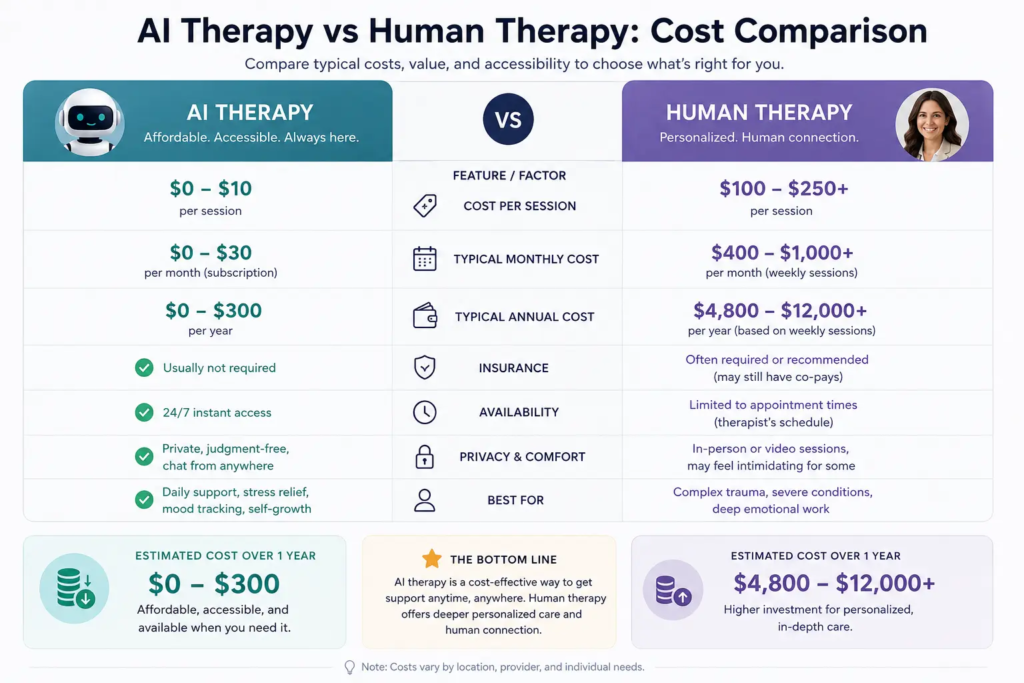
Step-by-Step: How I’d Approach This If I Were Starting Today
If you’re trying to figure out your own therapy budget, here’s the actual process I’d follow now, knowing what I know:
Step 1: Check your insurance first, always. Call the number on the back of your card and ask specifically: “What’s my mental health copay, and has my deductible been met?”
Step 2: Try a free AI tool for two weeks before committing money anywhere. Wysa and Woebot both had free tiers when I used them. This gives you a low-stakes way to see if you even like the format of typing out your feelings to something that isn’t human.
Step 3: Use AI apps as a bridge, not a replacement, if your issue feels serious. If you’re dealing with grief, trauma, relationship breakdowns, or anything that feels layered and long-term, budget for at least a few human sessions even if it means saving up first.
Step 4: Ask about sliding scale fees. Tons of human therapists offer reduced rates based on income, but they don’t advertise it. You have to ask directly. My therapist dropped my rate from $130 to $90 once I explained my situation.
Step 5: Look into community mental health centers. Depending on where you live, these can charge $20–$60 a session based on income, way below private practice rates. Search “community mental health center” plus your city name.
Step 6: If cost is still the blocker, combine both. AI app daily, human therapist every two to three weeks instead of weekly. It cut my monthly human therapy cost almost in half while still giving me that deeper check-in.
Mistakes I’d Avoid Next Time
- Don’t assume free trial periods on subscription apps like BetterHelp auto-cancel. Mine didn’t, and I got charged for a month I wasn’t using.
- Don’t pick a human therapist purely based on lowest copay. I did this once with a previous provider and the fit was so bad I wasted three sessions before switching.
- Don’t expect an AI chatbot to handle a crisis. If you’re in real distress, these apps usually aren’t built for emergencies, and most will just point you to a hotline anyway. Save yourself the frustration and go straight to a crisis line or emergency services if that’s where you’re at.
- Don’t ignore the fine print on what counts as a “session” in app subscriptions. Some count a single chat exchange, others let you message unlimited within the month.
So Which One’s Actually Worth the Money?
Honestly? It depends on what you’re solving for.
If you want daily emotional check-ins, help noticing your own thought spirals, or just something to talk to that isn’t going to judge you at 1am, the AI apps are genuinely worth the eight or nine bucks a month. I still use Wysa occasionally, mostly on days I don’t want to “perform” being okay for another human.
But if you’re working through something that has roots — old patterns, trauma, relationship dynamics that keep repeating — paying for a real therapist, even if it means fewer sessions per month, made a bigger difference for me than I expected going in.
The cheapest option isn’t always the better deal. Sometimes it’s the one that actually moves the needle, even if it costs more upfront.
If your budget is tight like mine was, don’t see this as an either/or choice. Mixing both, the way I eventually did, might be the most realistic way to get support without draining your savings account.








Leave a Reply