


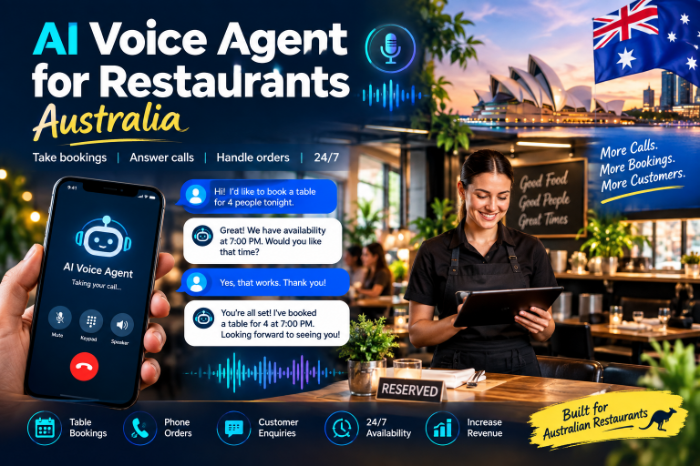
AI Voice Agent Restaurants Australia
I Watched a Sydney Café Stop Losing Orders to a Ringing Phone — Here’s What AI Voice Agents Are Actually Like
A mate of mine runs a mid-sized Italian place in the inner west of Sydney. Every Friday and Saturday night, the same thing happened: the phone would ring off the hook during the 7-8pm rush, nobody could grab it because the floor was slammed, and by the time someone had a spare thirty seconds, the caller had already hung up and ordered from the place next door.
He worked it out roughly — one in three calls just weren’t being answered. In hospitality, that’s not a minor inconvenience. That’s rent money walking out the door every single week.
That’s the exact problem AI voice agents are trying to solve, and over the last few months I’ve actually poked around with a few of these systems — partly out of curiosity, partly because he asked me to help him figure out if it was worth the money. So this isn’t a “here’s what AI voice agents are” explainer written from a press release. This is what it’s actually like setting one up, using one, and dealing with the weird moments when it doesn’t quite work.
So What Even Is This Thing?
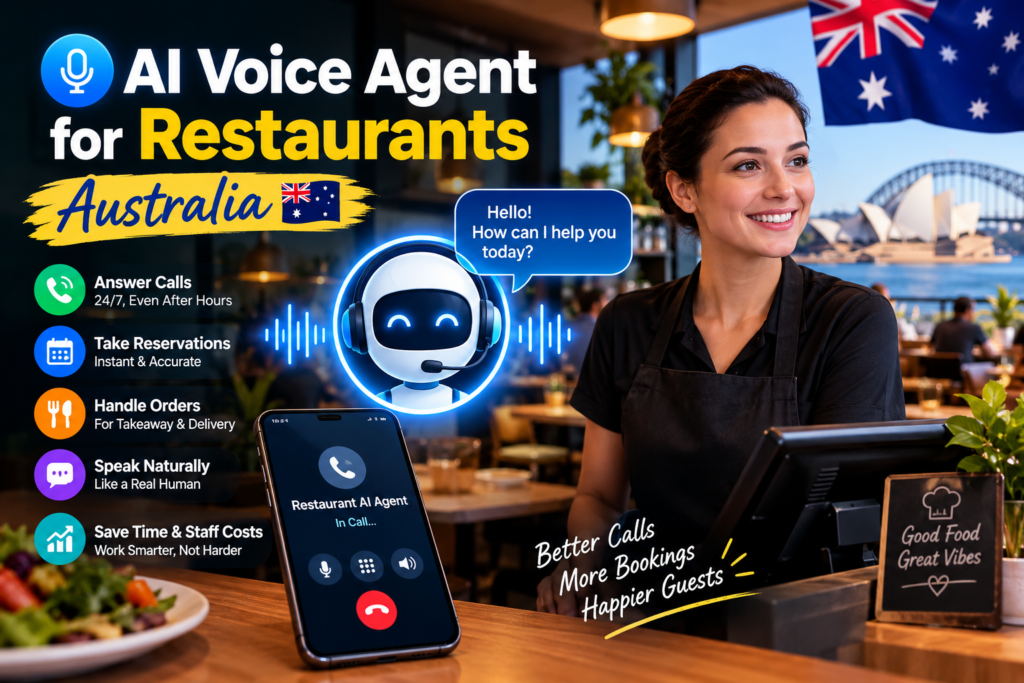
Basically, it’s a piece of software that answers your restaurant’s phone instead of a human. Not a robotic “press 1 for bookings” system — an actual voice that talks back, understands what the caller wants, and does something useful with it.
It can:
- Take a table booking and check if you’ve actually got room
- Take a phone order for pickup or delivery and send it straight to the kitchen printer or POS
- Answer the boring but constant questions — “are you open on Anzac Day?”, “do you do gluten free?”, “how much is delivery?”
- Send a text confirmation so the customer isn’t left wondering if it actually worked
- Pass the call over to a real person when something’s too complicated for it to handle
It’s not magic. It’s a language model (similar tech to ChatGPT, just tuned for phone conversations) hooked up to speech recognition and text-to-speech, wired into your booking system or POS.
Why This Actually Matters for Australian Venues Specifically
There’s a hospitality-specific reason this is becoming a bigger deal here, not just overseas. Staffing in Australian restaurants is genuinely brutal right now — high turnover, penalty rates on weekends, and most venues running lean rosters just to keep the books balanced. Nobody’s got a spare person whose only job is answering the phone.
Otto, one of the first AI ordering telephone agents built specifically for the Australian market, points to research showing that around 71% of inbound restaurant calls are actually revenue-related — bookings, takeaway orders, catering enquiries — and roughly a third of those calls go unanswered. That number lined up almost exactly with what my mate had estimated just by eyeballing his own missed call log, which honestly surprised me a bit.
What I found interesting about the Australian setup specifically is that some of these tools are built to go live with basically nothing — no new app, no big software overhaul, just a phone number and the printer you already own. That’s a very different pitch to some of the bigger international platforms, which often want you to switch your whole POS system over.
Setting One Up: What It’s Actually Like
Here’s roughly how the process went when we trialled one on his café for a few weeks (I won’t name the exact vendor since pricing and features change constantly, but the workflow is pretty similar across most of them — Otto, OmniDimension, and Retell AI all follow a similar pattern).
Step 1: Load the menu and hours in. This took longer than expected — not because it’s technically hard, but because his POS menu had about six years of “temporary” specials still sitting in it that nobody had bothered to delete. Clean your menu data before you start. Step 2: Set the escalation rules. You decide what the AI is allowed to handle on its own, and what it should hand off to a human. We set it to escalate anything involving allergies beyond the basics, large group bookings (10+), and complaints. This bit matters a lot — more on that below.
Step 3: Run test calls. Before it ever touches a real customer, you call it yourself, pretending to be difficult customers. Order something not on the menu. Ask for a booking during a time slot that doesn’t exist. Mumble. Talk over background noise. This is where you catch the embarrassing stuff before your actual customers do.
Step 4: Connect the number. Most systems let you keep your existing landline number and just forward calls, or port the number over entirely. We kept the existing number and just forwarded after-hours and overflow calls first, as a soft launch.
Step 5: Go live in stages. We didn’t switch it on for every call straight away. First it only picked up after-hours calls (when no human was ever answering anyway, so there was zero downside), then it took overflow calls during peak times, and only after a couple of weeks did it become the default answerer.
What Actually Worked
The after-hours bookings were the clearest win, no contest. People calling at 10:30pm to book a table for the next night, or asking “are you doing Mother’s Day bookings yet” — calls that used to just go to voicemail and often never got a callback — were now getting handled properly, with a confirmation text sent straight away. AI Voice Agent Restaurants Australia
Order accuracy was better than I expected too. It didn’t mishear “no onion” as “no onions” and mess up someone’s order, which was one of my actual worries going in.
Capturing details like allergies, celebrations, and special requests happened reliably, and the system correctly bumped anything genuinely tricky to a human — which matched what we’d configured, but it’s still satisfying to see it actually respect the settings under real pressure. AI Voice Agent Restaurants Australia
Where It Fell Over (Because It Did)
I’m not going to pretend this was flawless, because it wasn’t.
Thick accents and background noise were the main issue. One older regular with a strong Italian accent (fitting, given the restaurant) got misunderstood twice trying to book a table for “eight” — the system kept hearing “ate.” Eventually it looped him to a staff member, which is exactly what should happen, but it was a bit clunky in the moment.
It struggled with genuinely weird, specific requests. Someone rang asking to modify a booking from three weeks ago that had a note attached about a wheelchair-accessible table. The AI handled the reschedule fine but didn’t carry the accessibility note across automatically. We caught it because staff double-checked, but that’s the kind of thing that could genuinely embarrass a venue if it slipped through.
Some customers just don’t like talking to a bot, full stop. A handful hung up as soon as they realised, and called back later hoping for a human. Not everyone, but enough that it’s worth knowing this happens.
Common Mistakes I’d Tell Anyone to Avoid
Don’t skip the test-call phase. It’s tempting to just flip the switch and see what happens, but that’s how you end up with a real paying customer as your first bug report.
Don’t let it handle everything from day one. Start with after-hours or overflow only. Build trust in stages, the same way you’d trust a new staff member with the simple stuff before handing them the whole floor. AI Voice Agent Restaurants Australia
Don’t set vague escalation rules. Be specific: allergy questions beyond basic categories, groups over a certain size, anything involving a complaint or refund, all go straight to a human.
Don’t assume it replaces your host entirely. It’s closer to a really reliable overnight and overflow worker than a full replacement for the person who greets people at the door and reads the room during a busy service.
Check your data before, not after. Old menu items, outdated hours, wrong delivery zones — all of this gets fed straight into what the AI tells customers. Garbage in, garbage out, same as with anything.
Is It Actually Worth It?
For a venue that’s genuinely losing bookings and orders to unanswered calls — which is most busy restaurants, cafés, and takeaway spots in Australia right now — it’s hard to argue against at least trialling it. The after-hours coverage alone paid for itself in my mate’s case within about six weeks, mostly from bookings that simply wouldn’t have existed otherwise.
still need to check in on it, listen back to a handful of calls each week, and update it when your menu or hours change. Think of it less like buying a gadget and more like onboarding a new team member — one that happens to work 24 hours a day and never asks for a Sunday off, but still needs training and the occasional correction. AI Voice Agent Restaurants Australia
If you’re running a venue and considering this, my honest advice is to trial it on your quietest, lowest-risk call type first — usually after-hours — before trusting it with your Saturday night dinner rush. Let it earn that trust the same way you’d let any new hire earn it.








Leave a Reply