


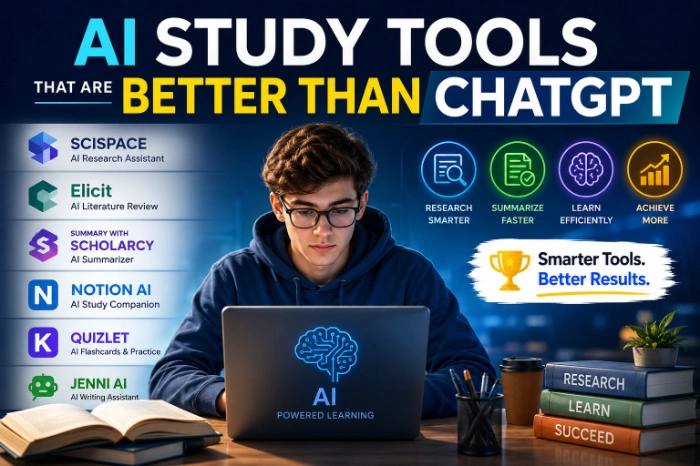
Ai study tools that are better than chatgpt
I Stopped Using ChatGPT for Studying — Here’s What Actually Works Better
Last semester I was three days out from an anatomy exam, sitting in a coffee shop with 90 pages of lecture slides open in one tab and ChatGPT open in another, copy-pasting chunks of text and asking it to “make flashcards please.”
It worked.By hour two I’d made maybe 40 cards and my coffee was cold and I still had two more chapters to go. Ai study tools that are better than chatgpt
That night I found out other students weren’t doing it this way at all. They were uploading whole PDFs straight into tools built specifically for studying, and getting flashcards, quizzes, and summaries in under a minute. I felt a little dumb, honestly. I’d been using a general-purpose chatbot to do a job that purpose-built tools do faster, cheaper, and with way less manual labor.
So I spent the next few weeks actually testing the alternatives on real coursework — not skimming landing pages, but uploading the same lecture recordings, the same messy PDFs, the same handwritten notes photographed on my phone. Here’s what I found.
Why ChatGPT isn’t really built for this job
ChatGPT is genuinely great at explaining things and having a back-and-forth conversation. If you want a concept broken down five different ways until it clicks, it’s still one of the best tools for that.
But studying isn’t just “understand a concept once.” It’s turning material into something you can drill, tracking what you’ve already mastered versus what keeps slipping, and reviewing it again in three days, then again in two weeks. ChatGPT doesn’t remember your last session unless you’re paying for the higher tiers and even then it’s not built around spaced repetition — the “review this again right before you’d forget it” science that actually makes memorization stick.
It also doesn’t take a 50-page PDF and hand you back an organized deck without a lot of manual copy-pasting on your end. That’s the exact problem I ran into at the coffee shop. Ai study tools that are better than chatgpt
The tool that actually replaced ChatGPT for me: NotebookLM
Google’s NotebookLM ended up being my biggest surprise. You upload your actual sources — PDFs, Google Docs, slides, even a YouTube lecture link — and it only answers based on what you gave it. No made-up facts, no vague textbook-generic answers.
What sold me was the audio overview feature. It turns your notes into something that sounds like two people casually discussing your material, podcast-style. I put one on during a grocery run before my anatomy exam and retained more from that 15-minute walk through the cereal aisle than from an hour of re-reading slides.
It recently added flashcards and quizzes generated straight from your own sources, which used to be Quizlet’s whole selling point. It’s also completely free, which matters when you’re a student watching every dollar.
The one gap: no real spaced repetition scheduler. It’ll quiz you, but it won’t tell you “hey, you’re about to forget this card, review it now.” For that you need something else in your stack. Ai study tools that are better than chatgpt
For actual long-term memorization: Anki
If NotebookLM is where I go to understand something, Anki is where I go to make sure I never forget it again.
It looks like it was designed in 2008, because basically it was. There’s no slick onboarding, no cute animations. But the algorithm behind it (SM-2, or the newer FSRS variant a lot of decks now use) is genuinely the gold standard for spaced repetition. It decides exactly when you’re about to forget a card and shows it to you right before that happens.
The other thing that changed my exam prep completely: community decks. For med school terms, the AnKing deck is basically legendary — years of other students’ curated work, free to download. I didn’t make a single card for my pharmacology unit. I just imported a deck other people had already built and refined.
Mistake I made early on: I tried to build my own 300-card deck from scratch in one sitting the night before a quiz. Don’t do that. Cramming defeats the entire point of spaced repetition — the system needs days, not hours, to actually space things out. Start decks at least a week ahead of an exam if you want the algorithm to do its job.
When you just need a pre-made deck fast: Quizlet
I’ll be honest, I don’t reach for Quizlet as often as I used to, but it still wins in one specific situation: when someone in your exact class already made a study set. With hundreds of millions of user-created decks, there’s a real chance your intro psych vocab list already exists, word for word, matched to your professor’s terminology.
Its AI flashcard generator (Magic Notes) works fine for quick, surface-level definition cards, but I found the questions shallower than what NotebookLM or Anki decks gave me. If you’re short on time and just need vocabulary drilled before a quiz tomorrow, it’s still hard to beat for speed.
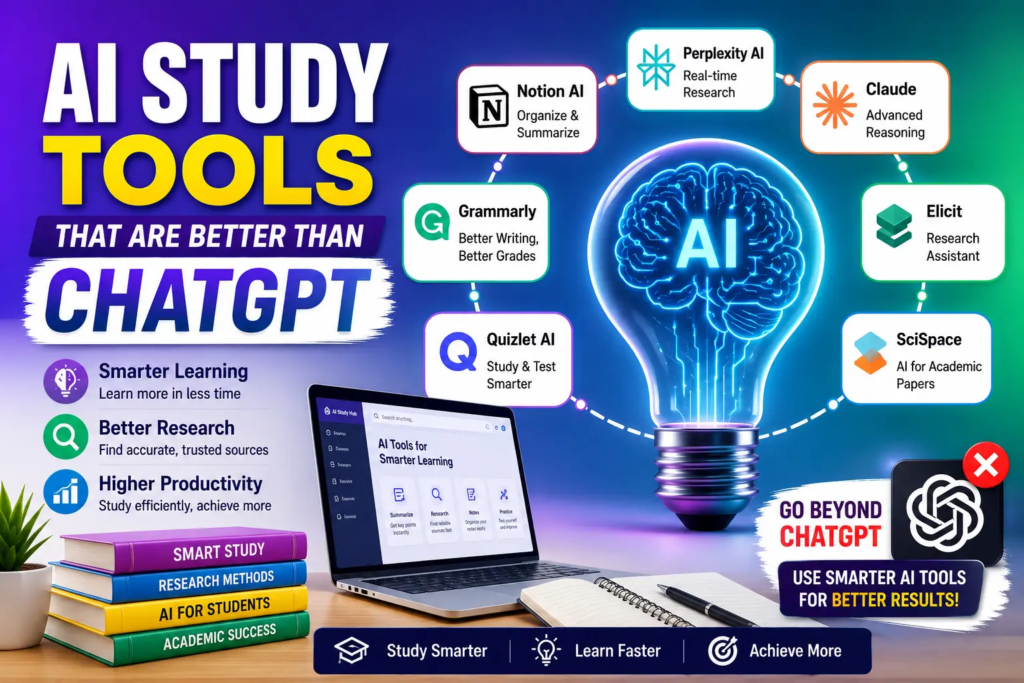
For lecture-heavy classes: look at tools built around audio
If your professor talks for 50 minutes straight and expects you to remember all of it, a text-only tool is going to leave gaps. This is where lecture-capture-style AI study apps earn their keep. I tested a couple that let you record a lecture on your phone and walk out with a summary, a flashcard set, and a short quiz by the time you’re back at your dorm.
The accuracy depends heavily on how loud and clear the room is — one lecture recorded near a rattling AC unit came back with several garbled terms I had to manually fix. Worth knowing before you rely on it for a class where every technical term matters.
What I actually use now (my real stack)
the combination that stuck: Ai study tools that are better than chatgpt
- NotebookLM for turning readings and slides into a source-grounded study companion, plus the audio overview for commute or gym review.
- Anki, started a full week before any major exam, using community decks where they exist and adding my own cards only for professor-specific details.
- ChatGPT or Claude, kept around for the conversational stuff — working through a problem set, getting a concept re-explained a different way, or checking my understanding of something before I turn it into a flashcard.
None of these tools replaced actual studying. They just cut out the hours I used to waste on formatting and card-making, and gave that time back to actual review.
Mistakes to avoid
Generating flashcards and never drilling them. This sounds obvious, but it’s the single biggest waste of time I see. A generated deck sitting unused does nothing. The AI part is the easy 10%; showing up daily to actually recall the cards is the 90% that matters.
Feeding it generic textbook content instead of your own material. Every tool I tested performed dramatically better when I uploaded my professor’s actual slides instead of a random chapter from an online textbook. Specific inputs produce specific, exam-relevant outputs.
Assuming AI-generated cards are always accurate. I caught a couple of factual slips in auto-generated quizzes, especially on dense STEM material. Skim what gets generated before you trust it fully — it takes thirty seconds and can save you from memorizing something wrong.
Using flashcards for subjects that need practice problems instead. Math, coding, physics — none of that is solved by flashcards. You learn those by doing problems, getting stuck, and doing more problems. Flashcard apps are a supplement there, not the main event.
Last thought
I don’t think ChatGPT is a bad study tool — I still use it most days. But treating it as the only tool is like using a Swiss Army knife when a proper toolbox is sitting right there. The purpose-built apps handle the repetitive, mechanical parts of studying so much better, and that frees up the actual thinking for you.
If you’re still doing the copy-paste-reformat dance I was doing at that coffee shop, give NotebookLM and Anki a real week’s trial before your next exam. It’s a genuinely different experience once the busywork disappears.





Leave a Reply