


AI College Essay reviewer
I Let an AI Tear Apart My Nephew’s College Essay. Here’s What Actually Happened.
Last October, my nephew Danish sent me his Common App essay draft at 11:47 PM with the message “can you read this real quick, deadline is in 6 hours.”
Six hours. For a 650-word essay that’s supposed to represent his entire personality to a college admissions officer who’ll spend maybe three minutes on it. ai college essay reviewer
I’m not an English teacher. I’m not a college counselor. I’m a guy who writes about tech for a living, so naturally my brain went “let’s throw this at an AI and see what happens.” What followed was a genuinely useful (and occasionally frustrating) few hours that taught me a lot about what AI essay reviewers can and can’t do.
I’m sharing all of it here because I know a lot of parents, students, and even tutors are wondering if these tools are worth trusting with something this important.
Why I even tried this in the first place
Here’s the thing about college essays — they’re weirdly personal to review. A teacher might be too busy. A parent is too biased (“everything my kid writes is brilliant”). A paid counselor costs anywhere from $150 to $300 an hour, and Danish’s family didn’t have that kind of budget lying around for a last-minute panic session.
So at midnight, I opened up ChatGPT in one tab, Claude in another, and a free tool called Grammarly in a third, and figured I’d compare notes. ai college essay reviewer
What I actually did, step by step
Step 1: I didn’t just paste the essay and say “fix this.”
That’s the mistake almost everyone makes. If you dump your essay into an AI chat and type “improve this,” you’ll get back a generic, sanitized version that sounds like it was written by a corporate LinkedIn post. I’ve seen this happen to at least three other students since.
Instead, I gave it context first. Something like: “This is a college admissions essay for a 17-year-old applying to study biology. The prompt is about a challenge he overcame. I want feedback on structure, clarity, and whether his voice feels authentic — not a rewrite. Please don’t change his wording unless something is genuinely confusing.”
That one instruction changed everything about the quality of feedback.
Step 2: I asked for specific, narrow feedback instead of “is this good?”
“Is this good?” gets you a vague pep talk. Instead I asked things like:
- Does the opening paragraph hook a reader in the first two sentences?
- Is there a clear “so what” — does the reader understand why this story matters to him?
- Are there any clichés admissions officers see a thousand times a year?
That last one was actually the most useful. The AI flagged that Danish’s essay opened with “Ever since I was young, I have always been passionate about…” — which, turns out, is one of the most overused openers in college essay history. I had no idea. Neither did he.
Step 3: I cross-checked between two different AI tools.
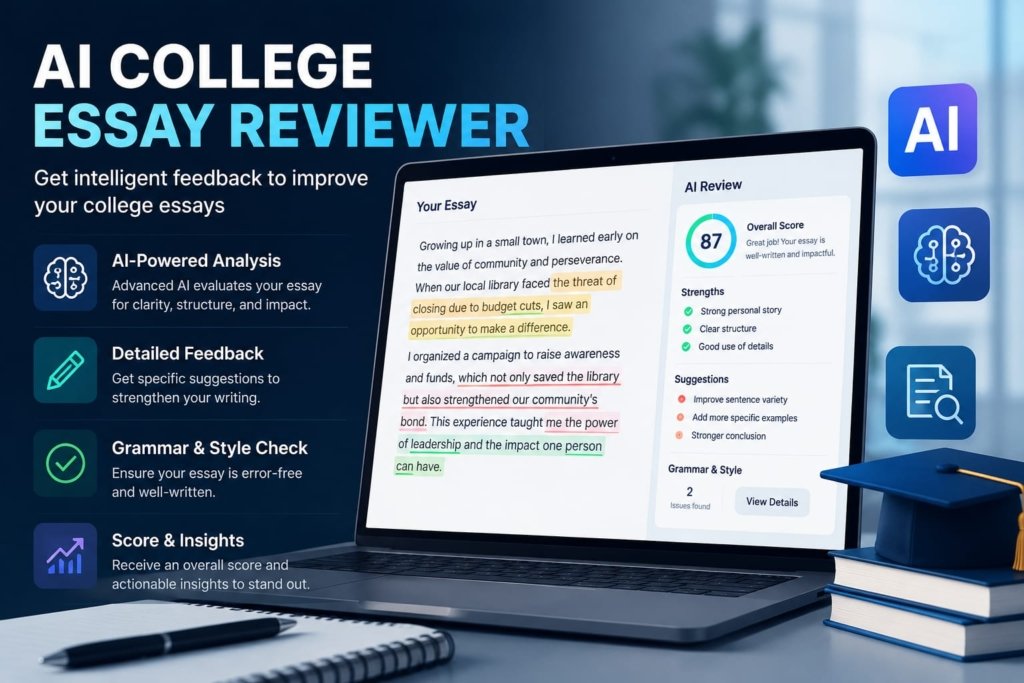
This is the part most people skip, and it’s the part I’d argue matters most. I ran the same essay through ChatGPT (GPT-4) and Claude, and asked both the exact same questions.
ChatGPT was more aggressive about restructuring — it wanted to move his third paragraph to the top for a “stronger hook.” Claude was more conservative and focused on tightening individual sentences without touching the overall structure.
Neither was “right.” But seeing where they disagreed told us which parts of the essay were genuinely weak (both flagged the ending as anticlimactic) versus which parts were just stylistic preference.
Step 4: I used Grammarly for the boring stuff only.
Grammar, punctuation, run-on sentences — that’s what Grammarly’s free version is actually good at. I didn’t use it for “is this essay compelling,” because that’s not really its job. It kept trying to make every sentence shorter and more “professional,” which is the opposite of what a personal essay needs. A 17-year-old’s essay is allowed to have personality and a little rhythm to it.
The mistake we almost made
Here’s the part I’m a little embarrassed about. On the second pass, Danish got excited about ChatGPT’s suggested rewrite of his opening paragraph. It was punchier. It sounded more “professional.” We almost used it wholesale.
Then I read it out loud, and it just didn’t sound like him anymore. It sounded like an essay. A good one, technically — but generic in a way that would blend into a pile of 40,000 other applications.
That’s the real risk with these tools. Admissions officers read thousands of essays. The ones that stick are the ones with an actual human voice, quirks included. AI, left unchecked, sands all that down.
We ended up keeping about 80% of his original wording and just using the AI feedback to fix pacing and cut two paragraphs that didn’t add anything.
Tools worth actually trying (and what each one’s good for)
ChatGPT (free or Plus) — best for brainstorming and getting a second opinion on structure. Ask it to play devil’s advocate on your thesis or point out where the “so what” is missing.
Claude — I personally found it gentler and better at preserving a student’s original voice when giving suggestions, which matters a lot for this specific use case.
Grammarly — good for catching typos, awkward phrasing, and grammar. Not great for judging whether an essay is emotionally compelling.
QuillBot — okay for rephrasing individual sentences if you’re stuck, but don’t run your whole essay through its paraphraser. It flattens voice fast.
A real human (teacher, counselor, older sibling who’s been through it) — still genuinely irreplaceable for the final gut check. AI tells you what’s technically off. A human tells you what feels off, and that’s a different, equally important thing.
A simple process that actually works
If you’re doing this for yourself or helping someone else, here’s the order I’d recommend now, after going through it:
- Write a full rough draft without any AI involved. Get your real thoughts down first.
- Read it out loud to yourself. You’ll catch half your problems just doing this.
- Feed it to an AI tool with clear instructions — ask for feedback, not a rewrite.
- Cross-check with a second AI tool if you have time. Look at where they agree.
- Go through suggestions one at a time and ask “does this still sound like me?” before accepting any change.
- Get one human to read the final version, even if it’s just a friend.
- Read it out loud one more time before submitting.
Common mistakes I’ve seen people make with this
Copy-pasting the AI’s rewrite directly into the application. Admissions readers see a lot of essays. Overly smooth, generic AI-flavored prose is starting to develop its own noticeable “tell,” and some counselors say they can spot it now.
Not giving the AI any context about the prompt or word limit. You’ll get feedback that ignores constraints you’re actually working within. ai college essay reviewer
Treating AI feedback as the final word. It’s a tool, not a verdict. Its job is to give you options and catch blind spots, not to decide what your essay should be.
Using it too early. If you run your very first rough idea through an AI before you’ve even figured out what you’re trying to say, you’ll end up writing what the AI thinks sounds good instead of what’s actually true to you.
Skipping the read-aloud step. This sounds unrelated to AI, but it’s the single best way to catch when a “fixed” sentence doesn’t actually sound like a real person anymore.
So, is it worth using?
Yeah, honestly. Danish’s final essay was noticeably tighter than his first draft, and more importantly, it still sounded like him when his mom read it — she actually said “this is so you” at the end, which felt like the real test passed. ai college essay reviewer
But it worked because we used the AI as an editor sitting next to him, not as a ghostwriter typing for him. That distinction is basically the whole game. Use it to ask better questions about your own writing, not to answer those questions for you.
He got in, by the way. Biology program, first choice. I’d like to take full credit but honestly, it was mostly his story to begin with — the AI just helped him tell it a little more clearly.








Leave a Reply