


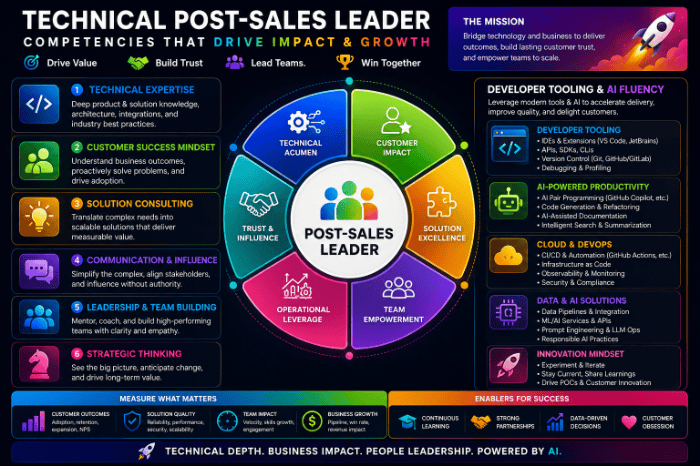
Technical post-sales leader competencies developer tooling ai
What Nobody Tells You About Becoming a World
Three years ago I sat in a Monday morning standup completely lost. My team was rolling out an AI-powered code review tool to a client whose engineers were, frankly, skeptical of anything that smelled like “AI will replace you.” I had the technical chops. I knew the product cold. But I had absolutely no idea how to lead a team through that kind of resistance while also keeping the implementation on schedule.
That morning taught me something I now repeat to anyone moving into post-sales leadership for developer tools: being good at the tech is maybe 30% of the job. The rest is people, process, and a weird kind of translation work that nobody prepares you for.
If you’re stepping into a customer success engineering role, a solutions architecture lead position, or any flavor of technical post-sales leadership in the developer tooling or AI space, this is the stuff I wish someone had told me before I figured it out the hard way.
The Job Isn’t What the Title Says It Is
When I got promoted from Solutions Engineer to Technical Lead, I assumed my day would look like a bigger version of my old day — more demos, more architecture diagrams, more API debugging sessions, just with a fancier title.
That lasted about two weeks.
What actually filled my calendar was mediating disagreements between my engineers and customer engineering teams, writing escalation summaries for executives who didn’t care about implementation details, and constantly reframing technical roadblocks into business language for people who just wanted to know “when will this work.”
The mistake I made early on: I kept solving problems myself instead of coaching my team to solve them. It felt faster in the moment. It was a disaster long-term. My engineers stopped flagging issues early because they knew I’d just swoop in and fix it. I had accidentally created a bottleneck where I was the bottleneck.
Competency One: Translating Between Engineers and Everyone Else
Developer tools and AI products live in a weird space. The people buying them are often technical leaders, but the people using them day-to-day range from junior developers to staff engineers who’ve seen every tool fad come and go.
A good technical post-sales leader has to speak both languages fluently — sometimes in the same meeting.
Here’s a real example. We had a customer using GitHub Copilot alongside an internal AI code assistant we’d built integrations for. Their VP of Engineering wanted a metric: “How much faster are developers shipping code?” My engineering team wanted to talk about token limits, latency, and model accuracy.
Neither side was wrong. But if I’d let the conversation stay technical, the VP would have checked out in five minutes. So I learned to do something simple: always lead with the business outcome, then offer the technical detail only if someone asks for it.
That one habit — outcome first, mechanism second — fixed more stalled meetings than any slide deck ever did.
Competency Two: Staying Technical Enough to Be Credible
Here’s the trap a lot of people fall into once they move into leadership: they stop coding, stop testing the product hands-on, and start relying entirely on what their team tells them.
I did this for about four months and got burned badly. A customer asked me a pointed question about how our AI model handled context windows during a live escalation call, and I gave a vague, outdated answer. The customer’s lead engineer corrected me in front of his whole team. Embarrassing doesn’t even cover it.Technical post-sales leader competencies developer tooling ai
After that, I built a personal rule: spend at least three hours a week actually using the product like a customer would. Not reading documentation. Not watching a demo. Actually building something with it, breaking it, and seeing what happens.
For AI dev tools specifically, this matters even more because the underlying models change constantly. What was true about GPT-4’s behavior six months ago might not be true about the current version. If you’re leading a team selling and supporting Anthropic’s Claude, OpenAI’s tools, or any LLM-based developer product, the ground is always shifting under your feet. You have to stay current or you lose credibility fast.
Competency Three: Reading the Room During Escalations
Every technical post-sales leader eventually deals with the 2 AM Slack message that says “production is down and it’s your tool’s fault.”
The instinct is to immediately defend your product or jump straight into technical troubleshooting. Both are mistakes, at least as a first move.
What actually works:
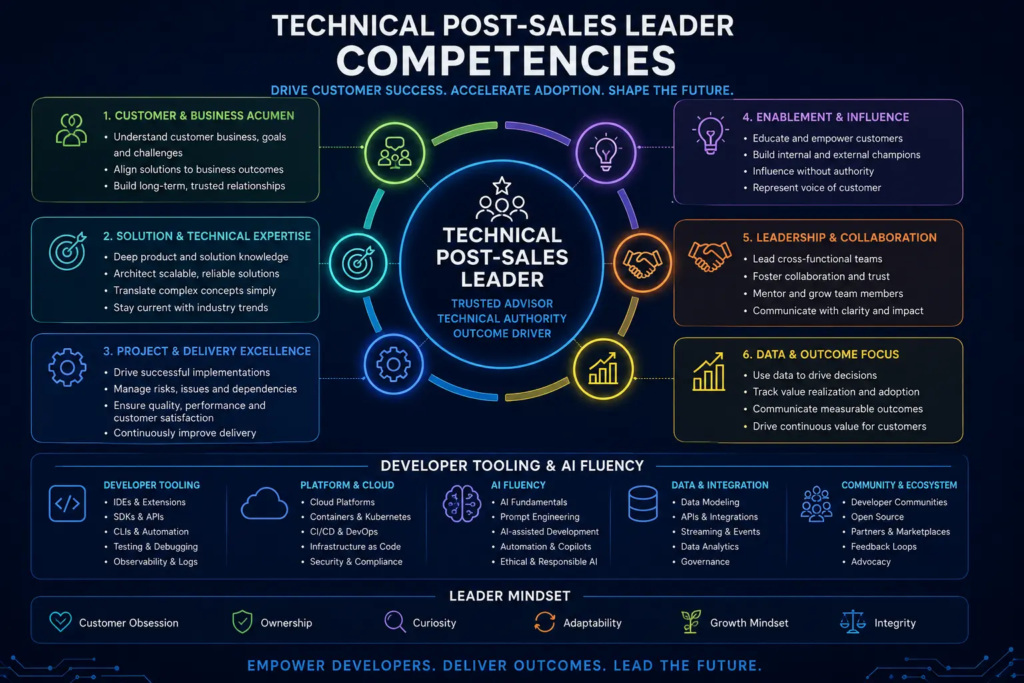
Step 1: Acknowledge the pain before anything else. A simple “I understand this is blocking your team and that’s serious, we’re on it” buys you goodwill and time.
Step 2: Get the right people in the room fast, not everyone. I used to over-invite people to escalation calls thinking more eyes meant faster resolution. It just meant more confusion and more people talking over each other.
Step 3: Separate “what’s broken” from “whose fault is it.” Customers care about the first thing way more than the second, even when they’re upset and looking to assign blame.
Step 4: Over-communicate during the fix, even when there’s nothing new to report. Silence during an outage feels worse than slow progress.
I learned step 4 the hard way after a customer’s CTO told us afterward that the technical fix was fine, but the radio silence for ninety minutes nearly cost us the renewal. The tool worked again. The trust didn’t fully recover for months.
Competency Four: Coaching Engineers Who Don’t Want to Be “Customer-Facing”
A lot of brilliant engineers end up in post-sales roles because their skills are needed there, not because they’re naturally drawn to client conversations. As a leader, you’ll manage people who are technically excellent but visibly uncomfortable on customer calls.
My approach changed over time. I stopped trying to make everyone into a polished presenter. Instead, I focused on pairing people strategically — putting a strong communicator alongside a deep technical expert on important calls, rather than expecting one person to be both.
This sounds obvious written down. It wasn’t obvious to me when I was new to leading a team. I kept trying to “fix” introverted engineers instead of building around their actual strengths.
Real Tools That Actually Matter in This Role
A few platforms became genuinely essential, not just nice-to-haves:Technical post-sales leader competencies developer tooling ai
- Linear or Jira for tracking technical issues raised during implementations, so nothing falls through the cracks between sales handoff and steady-state support.
- Slack Connect channels with customers for fast, informal communication during critical rollouts — way more effective than email chains for this kind of work.
- Gainsight or Vitally for tracking customer health signals before they become escalations, which honestly saved us from at least two near-churns I know of.
- Postman or Insomnia for quickly testing API behavior live during customer calls, which builds enormous credibility when you can show, not just tell.
- Notion for internal playbooks documenting how to handle common technical objections, especially around AI-specific concerns like hallucination rates or data privacy.
None of these tools fix bad leadership. But the right ones remove friction so your actual competencies can show up clearly.
Mistakes I’d Tell My Past Self to Avoid
Looking back, a few patterns kept tripping me up:Technical post-sales leader competencies developer tooling ai
I assumed technical respect would automatically translate into leadership respect. It doesn’t. Being the smartest person on the call doesn’t mean people will follow your direction during a crisis.
I avoided giving hard feedback to senior engineers on my team because I worried it would damage the relationship. It actually damaged things more, because problems festered instead of getting addressed early.
I treated every customer escalation the same way, regardless of size or strategic importance. That burned out my team on smaller issues while sometimes under-resourcing genuinely critical ones.
I underestimated how much customers in the AI tooling space need reassurance about reliability and trust, not just feature functionality. Especially right now, a lot of engineering leaders are still cautious about AI tools touching production code or sensitive data. Addressing that concern directly, early, and honestly builds more trust than any feature list.
Where This Actually Goes
The leaders who do well in this space long-term aren’t the ones who know every API endpoint by heart. They’re the ones who can sit in a tense room, understand both the technical reality and the human frustration in it, and find a path forward that respects both.
If you’re moving into this kind of role, give yourself permission to be bad at the people-management parts at first. Nobody walks in fully formed. The leadership skills are the ones you’ll actually be building for the rest of your career, one messy escalation call at a time.








Leave a Reply