


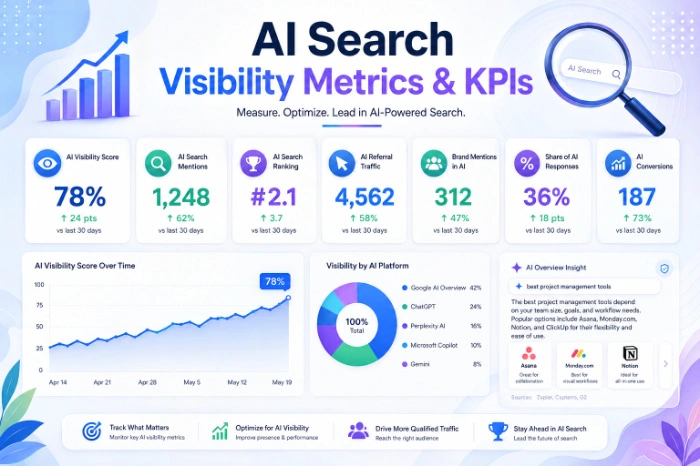
AI Search Visibility Metrics Kpis
What I Actually Track
A few months back, I was staring at my Google Analytics dashboard feeling pretty good about myself. Organic traffic was flat, sure, but “flat” felt like winning in a year where everyone was panicking about AI search killing their blogs.
Then a friend asked me, “Hey, does your site show up when you ask ChatGPT about [my niche topic]?” I typed the question in. Nothing. Not even close. My competitor’s blog post, which honestly wasn’t as good as mine, got quoted word for word.
That’s when it hit me — I had been measuring the wrong things this whole time. Google Search Console and my usual SEO checklist weren’t going to tell me anything about how I was doing inside ChatGPT, Perplexity, Google’s AI Overviews, or Claude. I needed a completely different set of numbers to watch.
So I spent the last few months figuring this out the messy way — testing things, tracking spreadsheets by hand (yes, really), and asking around in a few SEO communities. Here’s everything I learned about what actually matters when it comes to AI search visibility, and how to track it without losing your mind.
Why Regular SEO Metrics Don’t Cut It Anymore
Traditional SEO metrics were built for a world where a search engine gives you ten blue links and you fight for position one. AI search doesn’t work like that.
When someone asks ChatGPT or Google’s AI Overview a question, there’s no “page one.” There’s just an answer — sometimes with a citation, sometimes without one. Your click-through rate doesn’t matter if the AI just tells the person the answer directly and they never visit your site at all.
I learned this the hard way. My rankings for a specific keyword were solid, top 3 on Google. But when I checked how AI Overviews answered the same question, my content wasn’t referenced at all. A completely different source — one ranking on page 2 of regular Google — was the one getting cited.
That’s the gap nobody warned me about.
The Metrics That Actually Matter Now
Here’s the stuff I now check regularly, roughly in order of how much I care about them.
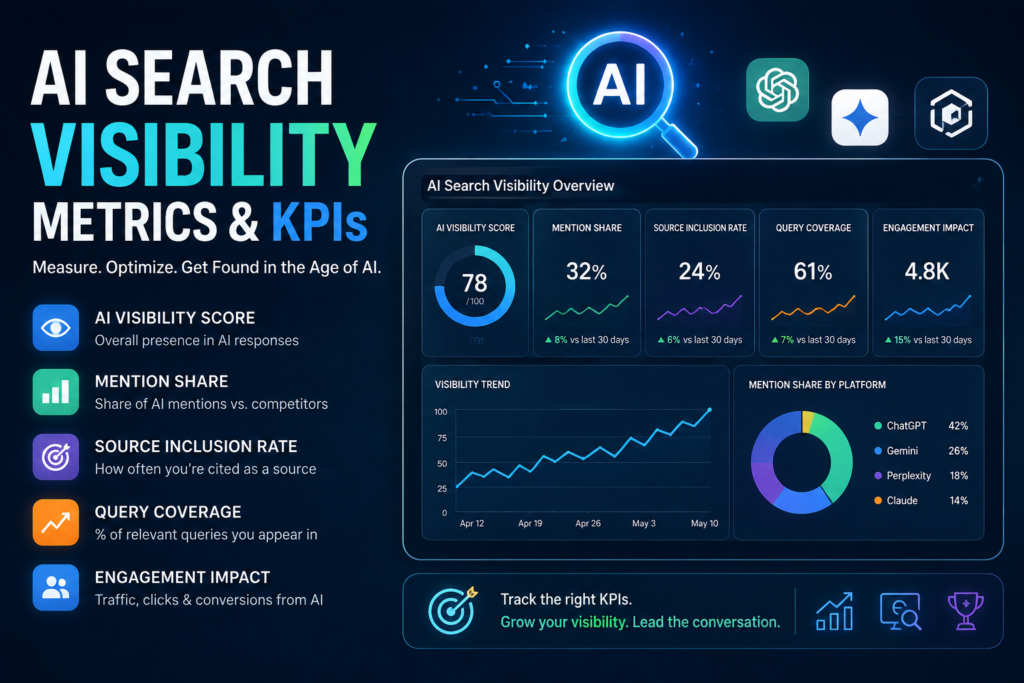
1. Citation Frequency (How Often You Get Mentioned)
This is basically the new “ranking position.” It’s how often your content actually gets pulled into an AI-generated answer, whether that’s ChatGPT, Perplexity, Gemini, or Google’s AI Overviews.
I track this manually right now because, honestly, the automated tools for this are still pretty young. My routine:
- I keep a list of 20-30 questions my target audience actually asks
- I note whether my site shows up, and where in the answer
It’s tedious, I won’t lie. But it’s the clearest signal I’ve found for whether AI search “trusts” my content.
2. Share of Voice in AI Answers
This is a step up from citation frequency. It’s not just “did I get mentioned,” it’s “compared to my competitors, how often am I the one getting mentioned?”
If I show up in 2 out of 10 relevant AI answers, but my competitor shows up in 7, that tells me something important — they’re winning the trust game even if my Google rankings look fine.
Tools like Profound, Otterly.ai, and Peec AI have started offering this kind of tracking. I tested Otterly for about a month, and it genuinely surprised me how often a smaller competitor site outranked mine in AI citations despite having way less traditional SEO authority.
3. Referral Traffic From AI Platforms
This one you can actually see in Google Analytics 4, and it’s oddly satisfying once you know where to look.
Go to Traffic Acquisition, then check your source/medium report for things like:
- chatgpt.com
- perplexity.ai
- copilot.microsoft.com
- gemini.google.com
For me, this traffic was basically zero six months ago. It’s still small, but it’s grown steadily, and it converts weirdly well. People coming from an AI chat tool already trust the answer they got and are clicking through because they want more detail — that’s a warmer visitor than a random Google searcher just skimming.
4. Content Extractability Score (My Own Made-Up Metric, But It Works)
This isn’t an official industry term, I just started using it for myself. Basically: how easy is it for an AI model to pull a clean, quotable answer out of your content?
I noticed my best-performing pages (in terms of AI citations) all had one thing in common — they answered the question directly within the first 2-3 sentences of a section, in plain language, without burying the answer under three paragraphs of fluffy intro.
My worst-performing pages did the classic blogger thing: long-winded story, then eventually the point.They want the answer fast, structured, and unambiguous.
5. Structured Data / Schema Coverage
I ignored schema markup for way too long because it felt like a “nice to have.” Turns out it’s doing real work for AI visibility.
FAQ schema, HowTo schema, and Article schema all help AI crawlers understand exactly what your content is answering. I added FAQ schema to about 15 of my older posts using RankMath (I use WordPress), and within a few weeks, 4 of those pages started showing up in Google’s AI Overview for question-based searches they weren’t showing up for before.
I can’t promise that’s a guaranteed cause-effect thing since so many factors change at once, but the timing was too clean to ignore.
Step-by-Step: How I Actually Track This Stuff Weekly
Here’s my real routine, not the theoretical version:
Step 1: Build a question list. I keep a running Google Sheet of real questions people in my niche ask — pulled from Reddit threads, “People Also Ask” boxes, and actual comments on my blog.
Step 2: Run the questions manually. Every week, I test 10-15 questions across ChatGPT, Perplexity, and Google AI Overview. I note: cited or not, position in the answer (first mention, buried, not mentioned).
Step 3: Check GA4 referral traffic. Five minutes, once a week. I’m watching the trend line more than the raw number.
Step 4: Track competitor citations too. If a competitor keeps showing up and I don’t, I actually read their page and compare structure, not just content quality.
Step 5: Update one old post per week. I don’t try to fix everything at once. I pick one underperforming post, tighten the intro, add a direct-answer paragraph near the top, and add FAQ schema if it’s missing.
Mistakes I Made (So You Don’t Have To)
Mistake #1: Obsessing over AI visibility and ignoring traditional SEO. I got so excited about this new frontier that I let my normal on-page SEO slip for about a month. Traffic dipped. Both things matter — AI visibility isn’t a replacement for solid SEO, it’s an extra layer on top.
Mistake #2: I published five new posts in one month hoping to increase my odds of getting picked up by AI tools. Barely moved the needle. What actually worked was rewriting three existing posts to be more directly answerable. Quality of structure beat quantity, every time.
Mistake #3: Not checking multiple AI platforms. I used to only check ChatGPT and assumed that represented “AI search” as a whole. Wrong. Perplexity behaves totally differently, favoring more recent and more source-diverse content. Google’s AI Overview leans heavily on pages that already rank well organically.
Mistake #4: Ignoring brand mentions outside my own site. AI models pull context from all over the web, not just your domain. I found forum threads and roundup articles mentioning my brand that were actually influencing how AI tools described me. Getting mentioned on other credible sites (guest posts, being quoted in roundups, Reddit discussions) seems to help AI tools trust and cite you more.
Real Example:
I had a post about home coffee grinders that got decent traffic but zero AI citations. I rewrote the intro to answer the core question in the first two sentences, added a comparison table, added FAQ schema, and trimmed 400 words of unnecessary backstory.
Three weeks later, that post started appearing in Perplexity answers for two related questions. GA4 showed a small but real bump in AI-platform referral traffic. Nothing dramatic, but it was proof the changes actually mattered.
Final Thoughts
AI search visibility isn’t something you can fake with a checklist, and honestly, nobody has this fully figured out yet — not even the “experts” writing confident LinkedIn posts about it. The tools for tracking this are still catching up to the problem.
What I’ve found works is treating it like an experiment you run continuously: track your citations, watch your referral traffic, fix one piece of content at a time, and stay a little skeptical of anyone who claims they’ve cracked the perfect formula.
If you’re just getting started, don’t overhaul your whole site. Pick five of your best-performing posts, tighten up the direct answers near the top, add schema where it makes sense, and start manually checking how AI tools respond to your core topics. That alone will teach you more than any tool subscription will in the first month.







Leave a Reply