


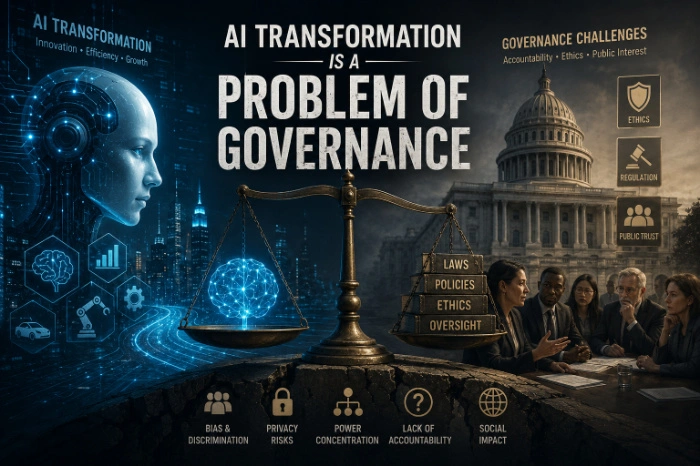
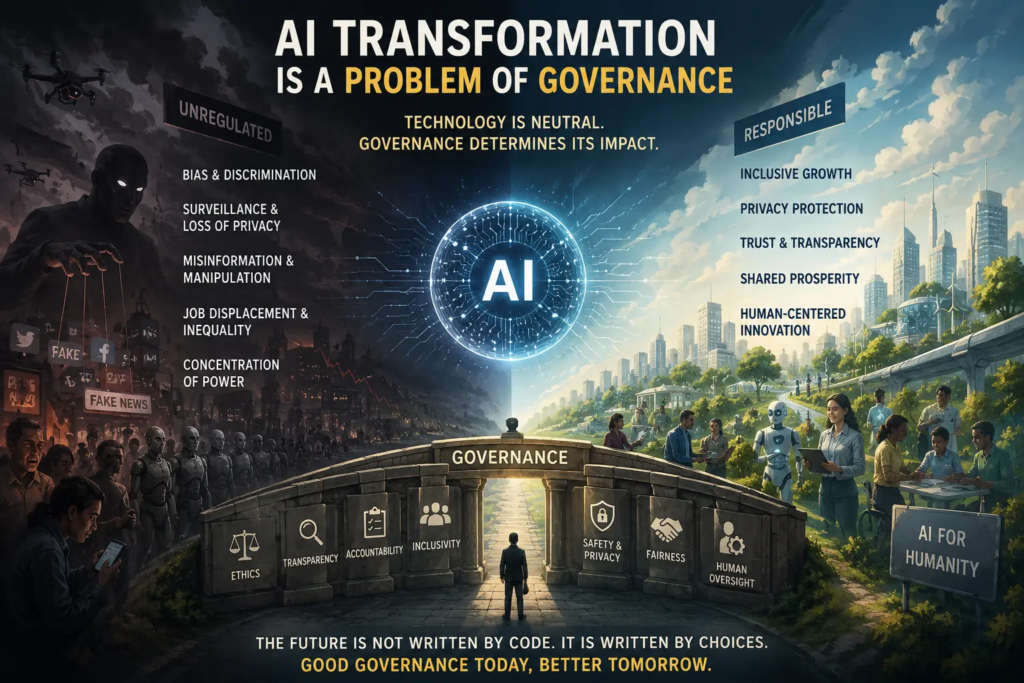
AI transformation is a problem of governance
AI Transformation Is Not a Tech Problem. It’s a Governance Problem. (I Learned This the Hard Way)
Two years ago, I sat in a meeting where a company had just spent close to $200,000 rolling out an “AI transformation initiative.” New tools, shiny dashboards, a chatbot for customer support, an AI writing assistant for the marketing team, even an AI-powered resume screener for HR.
Six months later, almost none of it was being used properly.
The chatbot was giving customers wrong refund policies. The marketing team quietly went back to writing everything manually because nobody had told them which AI outputs were “safe” to publish. And HR had paused the resume screener entirely after someone asked a very uncomfortable question: “Wait, who approved this thing to reject candidates automatically?”
Nobody had a good answer.
That’s when it clicked for me. The problem was never the AI tools. The problem was that nobody had decided who owns decisions, who checks the output, and who’s accountable when something goes wrong. In other words — nobody had governance.
I’ve since worked with a handful of small businesses and teams going through the same “let’s adopt AI” phase, and I keep seeing the exact same pattern. So this article is basically everything I wish someone had told me before that $200k mess. AI transformation is a problem of governance
Why Everyone Gets This Backwards
Most companies treat AI adoption like buying a new printer. You research it, you buy it, you plug it in, done.
But AI isn’t a printer. It makes judgment calls. It writes things, recommends things, sometimes decides things — and it does this at a scale no single manager can manually double-check.
The real question is: “Who is responsible for what this AI does, and how do we know when it’s wrong?”
That’s a governance question, not a shopping question. And almost nobody budgets time or people for it.
What “Governance” Actually Means Here (No Corporate Jargon)
Turns out, in the context of AI, it just means answering a few very practical questions before you roll anything out:
- Who is allowed to approve what the AI produces before it goes live?
- What happens when the AI gets something wrong?
- Where is it not allowed to make decisions at all (like firing someone, denying a loan, rejecting a job applicant)?
- Who checks the data going into the tool, so it’s not learning from garbage or biased history?
- How do employees flag a bad output without fear of “breaking the AI project”?
If you can’t answer these five things clearly, you don’t have an AI strategy — you have an AI experiment running loose in your business.
A Real Example: The Resume Screener Disaster
I’ll walk you through the HR situation because it taught me the most.
The company used an AI tool (a fairly well-known applicant tracking system with a built-in screening feature) to filter resumes for a marketing role. It was supposed to save time.
Here’s what actually happened, step by step:
- The tool was configured using past “successful hire” data from the last 5 years.
- Nobody checked what that historical data actually looked like.
- Turns out, past hiring had unintentionally favored candidates from 3-4 specific universities.
- The AI “learned” that pattern and started silently deprioritizing anyone outside those schools — including genuinely stronger candidates.
- Nobody caught it for two months because no one was assigned to audit the outputs.
The fix wasn’t “turn off AI forever.” The fix was governance:
- HR now manually reviews a random 10% sample of AI-filtered rejections every week.
- Any resume scoring in the “gray zone” gets a human second look, not an automatic rejection.
- The tool’s criteria settings are reviewed quarterly by two people, not one.
Nothing fancy. No new technology. Just clear ownership and a review process.
Step-by-Step: How to Actually Govern Your AI Rollout
If you’re in charge of bringing AI into your team, business, or department, here’s the practical sequence I now use with every client. It’s not glamorous, but it works.
Step 1: List every place AI touches a decision, not just a task
Writing an email draft = low risk. Deciding who gets a discount, who gets flagged as fraud, who gets hired = high risk.
Separate these into two buckets before you do anything else.
Step 2: Assign a human owner to every AI tool, by name
Not “the marketing team.” An actual person. If something goes wrong with the AI writing tool, who gets the message at 9pm? Write their name down. Seriously.
Step 3: Set a review rhythm, not a review “someday”
Weekly for high-risk tools (hiring, finance, customer-facing decisions). Monthly for lower-risk stuff (content drafts, internal summaries). Put it on a calendar. If it’s not scheduled, it won’t happen — I’ve watched this fail in real time at three different companies.
Step 4: Create a “kill switch” rule
Before launch, decide: what specific outcome would make us immediately pause this tool? Write it down. For the resume screener, it should have been: “If rejection rates differ significantly by school, region, or background, pause and review.” Nobody wrote that rule down beforehand, which is exactly why it went unnoticed. AI transformation is a problem of governance
Step 5: Make it safe to report a bad output
This one gets skipped constantly. If an employee feels like flagging a weird AI output makes them look like they’re “against innovation,” they’ll stay quiet. Build a simple, blame-free channel — even just a shared form or a specific chat channel — where anyone can say “hey, this looked off” without it turning into a whole thing.
Step 6: Document the decision trail
When the AI makes or supports a decision (approving content, screening a candidate, flagging a transaction), keep a simple log of what it decided and who reviewed it. Even a basic spreadsheet is fine for smaller teams. This isn’t bureaucracy for its own sake — it’s the only way you’ll spot a pattern before it becomes a scandal. AI transformation is a problem of governance
Tools That Actually Help With This (Not Just Theory)
A few things I’ve seen work well in practice, for smaller teams :
- Notion or Airtable for tracking which AI tools are in use, who owns them, and review dates. Simple, visible, nobody can claim they “didn’t know.”
- Dedicated chat channels for AI feedback — literally just a channel where anyone can drop a screenshot of something weird and tag the tool owner.
- Built-in activity logs in tools like Microsoft Copilot, Google Workspace’s AI features, or various CRM AI add-ons. Most modern platforms have some form of activity log. Most teams never turn it on or check it.
- Regular “AI output spot checks” — literally just pulling 10-20 recent outputs and reading them together as a team once a week. Costs nothing, catches a lot.
Mistakes I See Constantly (And Made Myself)
Mistake 1: Treating AI adoption as an IT rollout. IT can install the tool. IT cannot decide who’s accountable for what it produces. That’s a leadership and process decision.
Mistake 2: No one reviewing the training data or inputs. Garbage in, garbage out isn’t a cliché — it’s exactly what happened with that resume tool.
Mistake 3: Assuming “AI-generated” means “already checked.” It’s the opposite. Anything AI touches needs more review at first, not less, until you actually trust the pattern of outputs.
Mistake 4: No clear line for high-stakes decisions. If AI is involved in anything touching money, hiring, legal, or health — there needs to be a hard rule that a human signs off, every single time, no exceptions.
Mistake 5: Rolling out to the whole company at once. Every successful rollout I’ve seen started with one team, ran for a few weeks, got reviewed, adjusted, then expanded.
Final Thoughts
Honestly, the tools themselves aren’t the hard part anymore. The major AI assistants out there are all genuinely capable, and getting better every few months. Setting them up takes an afternoon. AI transformation is a problem of governance
What takes real work is deciding who’s watching, who’s accountable, and what happens when something slips through. That part doesn’t get solved by a better model or a fancier dashboard. It gets solved by people sitting down and actually deciding how this thing gets used responsibly in their specific business.
If you’re about to roll out AI somewhere — in your team, your company, even just for yourself — spend an hour on the governance side before you spend another dollar on the tool side. It’s the boring part. It’s also the part that saves you from becoming someone else’s cautionary story, like the one I just told you.







Leave a Reply